The short version
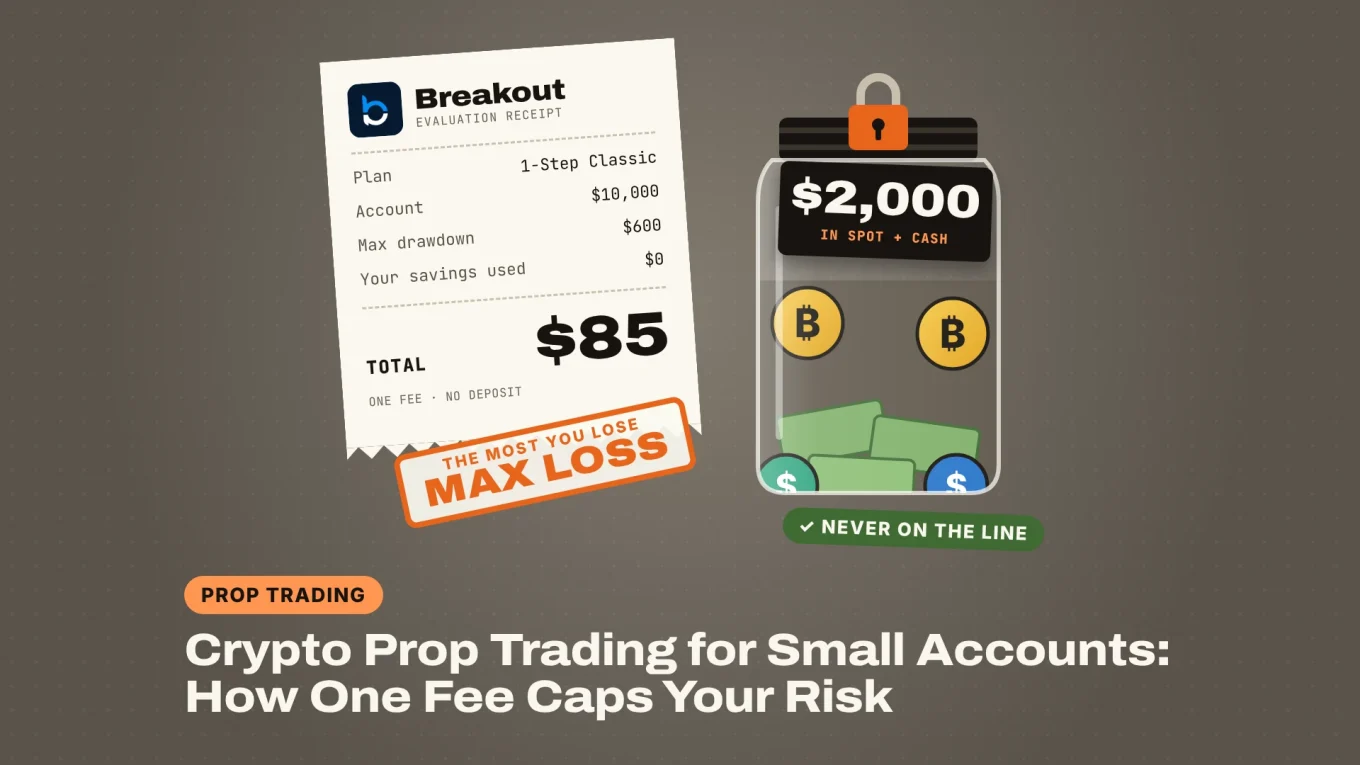
- Crypto prop trading lets a small trader risk a one-off fee instead of savings: a $10,000 Breakout evaluation costs $85, and a pass pays 80% of profits.
- On a $2,000 account, 0.5% risk is $10 a trade; on the $10,000 evaluation it is $50, while the $2,000 stays in cash or spot and can’t be liquidated.
- The catch: most traders fail the first attempt and every retry costs the full fee, so set an attempt budget, like three tries or $255, before the first trade.
Crypto prop trading flips the usual small-account problem on its head. Instead of putting your own $2,000 on a futures exchange, you pay a one-off fee, $85 for a $10,000 evaluation at Breakout, and trade a simulated account with somebody else’s rules. Pass, and you keep 80% of what you make on it.
The fee is the whole bet. Your savings never touch the exchange, so they can sit in cash or spot Bitcoin while you trade. So is this a smarter way to trade a small portfolio, or just a cheaper way to lose?
Breakout put the whole model in four lines this week:

How funded trading works at Breakout:
1. Buy an evaluation. One fee.
2. Hit the profit target without touching either loss limit.
3. Your account upgrades to funded automatically.
4. Keep 80%. Request a payout any time it hits $50.
That's literally it.
How Does Crypto Prop Trading Work?
You buy an evaluation, hit a profit target without breaking two loss limits, and get a funded account that pays out real money. All trading happens on a demo account, but Breakout’s help center says fills follow the live order book, so a big order slips just as it would on an exchange.
Breakout has been owned by Kraken since September 2025, when the exchange completed the acquisition. It was co-founded by the traders Mayne and Cred, whose risk lessons are on our Videos page. Like most crypto prop trading firms, it sells evaluations, three one-step ones in its case. Here is what each asks of a $10,000 account:
| Plan | Price | Profit target | Max drawdown | Daily loss limit |
|---|---|---|---|---|
| 1-Step Classic | $85 | $1,000 (10%) | $600 (6%) | 3% |
| 1-Step Pro | $65 | $1,200 (12%) | $500 (5%) | 3% |
| 1-Step Turbo | $40 | $900 (9%) | $300 (3%) | 3% |
The max drawdown is static: on Classic, the account dies at $9,400 no matter how high it climbed first. The daily limit is 3% of the balance at 00:30 UTC, and open trades count against it. There is no time limit and no minimum number of trading days.
Sponsored · Affiliate link
Save 5% when buying Breakout Prop evaluations
Base Camp may earn a commission if you sign up. It never affects what we write.
The Small-Account Problem: $20 a Trade
A small account is hard to trade well. On $2,000, the 1% rule says you risk $20 per trade. Ten losers in a row cost about $191, which is survivable. But a good month at 1% risk might make $100 to $200, and that is where most small traders get impatient.
So they size up. At 5% a trade, the same ten losers take the account from $2,000 to about $1,197, a 40% hole that needs a 67% gain just to get back. Add leverage and one bad wick can do it in an afternoon. The money at risk is the money you saved.
A Worked Example: $2,000 in Spot, $85 on the Line
Now split the same trader in two. The $2,000 stays put, in stablecoins or DCA’d into spot Bitcoin. Spot can still fall, but it can’t be liquidated. Separately, they buy a $10,000 Classic evaluation for $85.
| Own futures account | $10,000 Classic evaluation | |
|---|---|---|
| Money at risk | $2,000 | $85 fee |
| Risk per trade at 0.5% | $10 | $50 |
| Most you can lose | the whole account | $85 per attempt |
| A 5% month pays | $100 | $400 (80% of $500) |
The prop firm’s account lets the trader risk five times more per trade while risking far less of their savings. Losing it costs $85. Twelve straight $50 losers would breach the $600 limit, so the sizing still has to be sane.
One payout covers a lot of attempts. A 5% month on a funded $10,000 account pays $400, enough for four more evaluations. Payouts start at $50, in USDC, and you can request one any time you have no open trades.
EXPLORE: Futures and Leverage Explained: Perps, Margin and How Liquidation Really Works
The Catch: Most Traders Fail, and Retries Add Up
Breakout doesn’t publish a pass rate, but its own disclosures say most applicants don’t pass on the first attempt. The evaluation fee is non-refundable and there are no resets: a breach closes your trades and you buy a new evaluation at full price. Five failed Classic attempts are $425, over a fifth of a $2,000 portfolio.
The fix is the same as in any trade: set the stop before you start. Decide how many attempts you will pay for, say three, or $255, and stop there if none passes. That turns crypto prop trading into a fixed risk for the whole portfolio instead of a habit.
The rules also matter more than the price:
- No copied trades. Breakout bans trading on signals, communities, social media posts or research reports from someone else. Your own plan only.
- Lower leverage. Bitcoin gets 10x, Ethereum and Solana 5x, and most smaller alts 2x or 3x.
- Costs still count. Trades pay a simulated 0.04% each way, and positions held past midnight UTC pay 0.033% a day, both taken from the demo balance.
- Paperwork to get paid. Passing makes you eligible, not funded: a KYC check and a separate funded-trader agreement with Payward Oceanic come first, usually within 12 to 24 hours. Payouts aren’t insured, and taxes are yours.
Who Crypto Prop Trading Fits, and Who Should Skip It
It fits the trader with a written plan, a few months of journaled trades and the patience to risk 0.5% at a time. For them, a small portfolio stays safe in spot or cash while their skill gets a bigger account to work with.
It doesn’t fit someone who needs a big win this month. The limits are tight on purpose, and a trader who blows a $2,000 account will usually blow a $10,000 evaluation faster. Pick your attempt budget first. If the plan only works with someone else’s trade ideas or 20x leverage, the cheapest option is not to buy one at all.
Thinking about a Breakout evaluation? Join the camp on Telegram and ask away. The crew is happy to help with any questions about the plans and the rules.