The short version
- Netanyahu crypto idea: on October 23 Israel’s prime minister said he has asked for a plan to keep the economy running if banks impose sanctions, with blockchain as “one of” the tools.
- The Bank of Israel answered a day later that “cryptocurrencies cannot serve as a means of circumventing sanctions”, and more than 100 economists warned against the idea.
- The crew is watching Tuesday’s election and the Fed on Wednesday, with BTC at $79,436 testing Saturday’s $79,221 low.
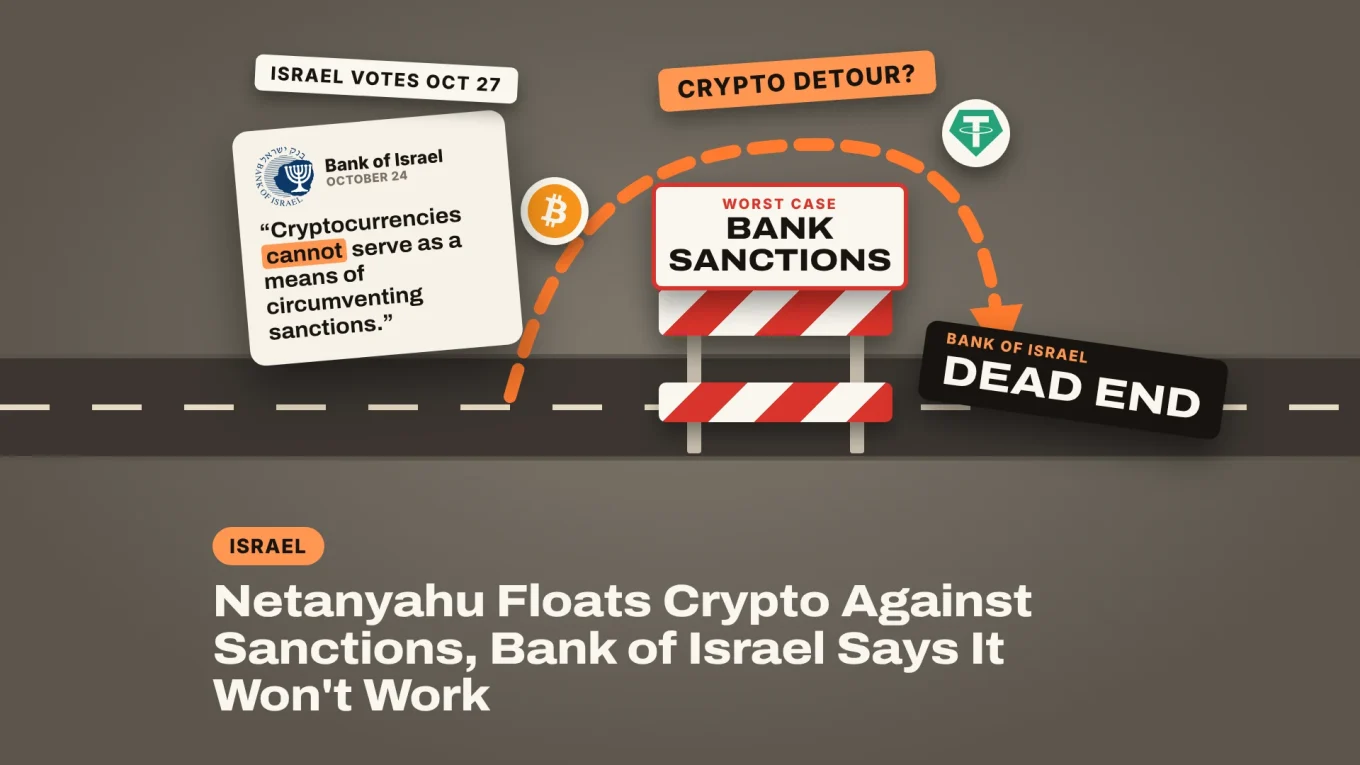
Netanyahu crypto talk is not something anyone expected three days before an Israeli election. On Friday, Prime Minister Benjamin Netanyahu said he had asked for a plan to keep Israel’s economy running if foreign banks cut it off, and that blockchain would be “one of” the tools.
A day later, the Bank of Israel gave its crypto verdict in public: “Cryptocurrencies cannot serve as a means of circumventing sanctions.” Israelis vote on Tuesday, October 27. So what did he actually propose, and could crypto do the job?
Kalshi flagged the request on Friday evening, 20:15 Copenhagen time:

JUST IN: Netanyahu requests blockchain plan to protect Israel's economy from potential sanctions
What Is the Netanyahu Crypto Idea?
He said Israel should prepare an alternative system in case banking sanctions hit, and that crypto could be part of it. In an interview with Channel 10, Israel’s business channel, on October 23, he said he had started preparing plans. Asked whether blockchain could be one of the ways, he answered: “One of them, certainly.”
He gave no details. He didn’t name a coin, a stablecoin or a budget, and no plan has been published. In a second interview, with Channel 14, he played it down: “crypto is one of the means, it is not the only one and I am not sure we will use it.”
The background is a run of measures against Israel over the war in Gaza and settlement building in the West Bank. On September 8, 12 countries, including the UK, France and Canada, announced steps against settlement activity, mostly aimed at trade in settlement goods. Israel sanctions so far have not touched its banks. Netanyahu says he has spent three years working to block sanctions and wants closer ties with Brazil and other Latin American countries.
Sponsored · Affiliate link
Save 20% on fees trading on WEEX
Base Camp may earn a commission if you sign up. It never affects what we write.
Why Did the Bank of Israel Push Back?
Because the central bank thinks the answer is to keep the trading partners, not to route around them. Its statement on Saturday night, October 24, said Israel should prevent sanctions rather than find ways around them and “preserve economic relations with its main trading partners”. It also said the decision itself belongs to the political level.
Netanyahu replied that he values the bank’s advice but will do what he thinks is right. The criticism didn’t stop there. More than 100 economists, former Bank of Israel governors and tech founders, including Nobel laureate Joel Mokyr, signed a letter on Sunday warning that sanctions on Israeli banks would cause “enormous and irreversible damage”. Opposition leader Gadi Eisenkot put the practical problem in one question: “How will Google buy an Israeli company on the condition that it bypass an international bank and pay in crypto?”
Netanyahu’s camp frames the idea as contingency planning for a worst case. His critics see the talk of a workaround as making that worst case more likely. Voters get their say on Tuesday.
DISCOVER: Russia’s Biggest Banks Open Crypto to Savers: VTB in November, Sberbank on December 1
Can Crypto Really Get a Country Around Sanctions?
Only at the edges, and the record of crypto sanctions workarounds so far is poor. A blockchain is a public ledger, so every transfer can be followed, and most of the liquidity sits in dollar stablecoins like USDT and USDC. Their issuers can freeze wallets, and they do when US authorities ask.
Russia is the live test. Its rouble stablecoin A7A5 moved more than $100 billion in under a year, Elliptic found in January, mostly as a bridge from roubles into USDT. Then came the pushback: exchanges froze accounts traced back to it, and daily volume fell from a peak above $1.5 billion to about $500 million.
Israel knows how traceable crypto is better than most. Its own National Bureau for Counter Terror Financing has issued seizure orders against crypto wallets since 2021, starting with 84 Hamas-linked addresses, and has since gone after accounts at major exchanges. The same transparency that lets Israel freeze those wallets would let others watch Israeli flows.
There is also the scale problem. Israel’s economy runs on dollar-paid tech exports, and its pension funds and reserves sit inside Western finance. Paying a supplier in USDT is possible. Running payroll, pensions and foreign trade for a country of 10 million through it is a different job.
Bitcoin Price Analysis: Where Is BTC Before Israel Votes and the Fed Decides?
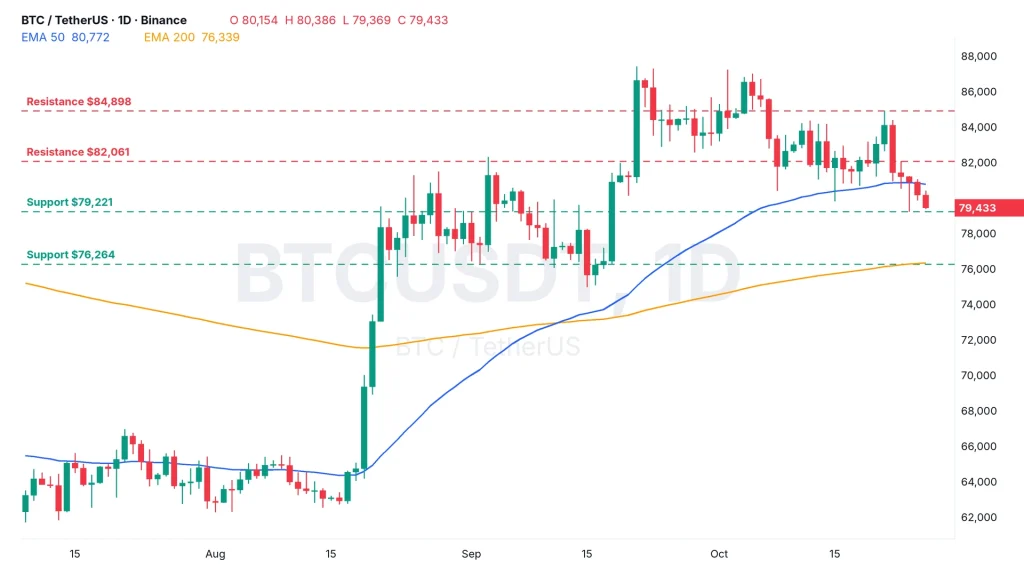
Just under its 50-day average, and testing Saturday’s low. The Bitcoin price is $79,436 at the time of writing, down 1.8% in 24 hours, below the 50-day EMA at $80,772. The Israel story isn’t moving Bitcoin; the Fed decision on Wednesday at 19:00 Copenhagen time is the bigger event this week.
- The first ceiling: $80,772. The 50-day EMA, lost on Sunday after holding it most of the month.
- The bigger ceiling: $82,061. Friday’s high, where the last bounce ran out.
- The floor to defend: $79,221. Saturday’s low, being tested right now.
- The deeper support: $76,264. The September 2 low, almost on the 200-day EMA at $76,339.
In the bull case, BTC reclaims the 50-day and retests $82,061 after the Fed. In the base case, it chops between $79,221 and $80,772 into Wednesday. In the bear case, a daily close under $79,221 opens the way to the 200-day near $76,300.
EXPLORE: Bitcoin vs Altcoins vs Stablecoins vs Memecoins: What You’re Actually Buying
Whether Netanyahu crypto plans ever leave the interview stage depends on Tuesday’s vote and on whether bank sanctions ever come. For now, the central bank has made its position clear, and the market hasn’t noticed.

In crypto since 2017. A technical trader with years of experience in DeFi and onchain data.
More from TANG →