
The short version
- Bitcoin ETF outflows hit $430.2 million on November 5, the biggest since October 30, with no fund taking in money.
- Fidelity’s FBTC lost $199.9 million a day after its $236.7 million buy, and BlackRock’s IBIT is down $1.04 billion over five red sessions.
- Ethereum ETFs lost $99.9 million, taking November to $271.9 million out.
- Next: the US jobs report at 13:30 UTC (8:30 a.m. in New York) on Friday, with BTC sitting just above support at $74,967. We’ll post Friday’s flows on Base Camp on X once Farside has them.
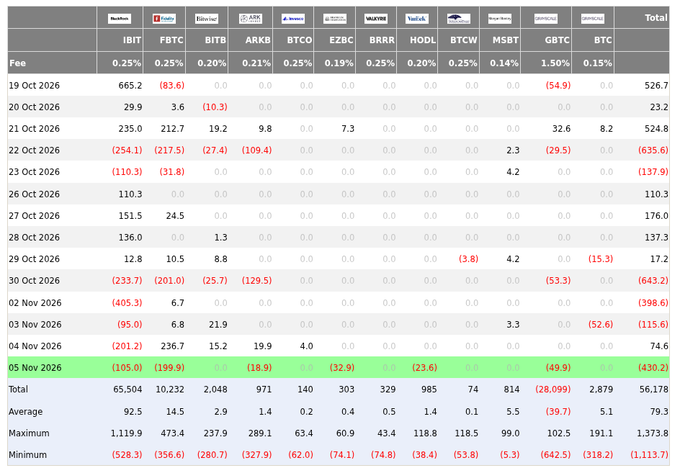
Fidelity changed sides in a day. Bitcoin ETF outflows reached $430.2 million on Thursday, November 5, the biggest daily exit since October 30, and not one of the twelve funds took in a dollar.
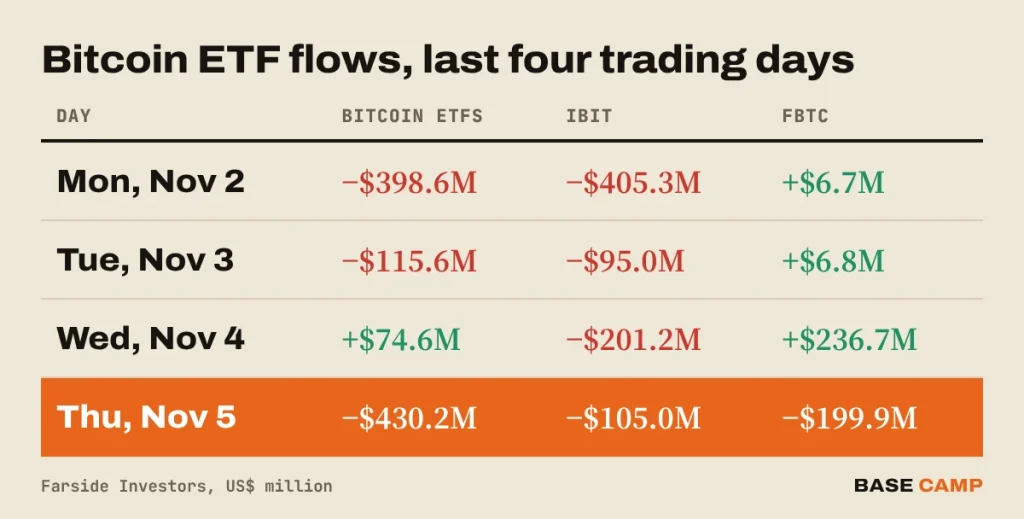
A day after its FBTC carried the market with $236.7 million of inflows, it lost $199.9 million, handing back 84% of Wednesday’s buy in one session. BlackRock’s IBIT lost another $105.0 million, its fifth red day in a row. BTC fell 5.5% on the day and closed at $76,088, its lowest close since September 15. Farside’s Thursday update has every fund:

𝗕𝗶𝘁𝗰𝗼𝗶𝗻 𝗘𝗧𝗙 𝗙𝗹𝗼𝘄 (𝗨𝗦$ 𝗺𝗶𝗹𝗹𝗶𝗼𝗻) – 2026-11-05
TOTAL NET FLOW: -430.2
IBIT: -105
FBTC: -199.9
BITB: 0
ARKB: -18.9
BTCO: 0
EZBC: -32.9
BRRR: 0
HODL: -23.6
BTCW: 0
MSBT: 0
GBTC: -49.9
BTC: 0
Who Drove Thursday’s Bitcoin ETF Outflows?
Six funds, one more than on October 30’s bigger exit. FBTC’s $199.9 million and IBIT’s $105.0 million made up 71% of the total. Grayscale’s GBTC lost $49.9 million, Franklin’s EZBC $32.9 million, VanEck’s HODL $23.6 million and ARK’s ARKB $18.9 million. The other six reported zero, per Farside.
IBIT outflows are now the bigger story in the background: $1.04 billion in five sessions since October 30, two and a half times the $410.6 million it took in during the dip buying from October 26 to 29.
Sponsored · Affiliate link
Save 20% on fees trading on WEEX
Base Camp may earn a commission if you sign up. It never affects what we write.
Wednesday’s Green Day Lasted One Session
Wednesday’s $74.6 million of Bitcoin ETF inflows came with a rally to $80,504. Thursday reversed both. Stocks sold off hard, with the Nasdaq 100 down 6.4%, and Bitcoin went with them. ETF flows are counted at the US close, 21:00 UTC (4:00 p.m. in New York), so Thursday’s sellers were reacting to the drop as it happened.
November is now $869.8 million in the red after four sessions, starting with Monday’s $398.6 million exit, and the five sessions since October 30 add up to $1.51 billion out. So far the month reads like a slow exit with one bounce, not a turnaround. Fidelity buying the bounce on Wednesday and selling the drop on Thursday is about as clear a sign of nervous money as this table gives.
Ethereum ETF Outflows Return After One Green Day
Ethereum ETF outflows came to $99.9 million on Thursday, per Farside, after Wednesday’s $53.0 million broke a seven-day losing run. BlackRock’s ETHA lost $75.2 million and its staked Ethereum fund ETHB $22.0 million, while Fidelity’s FETH ($2.2 million) and Grayscale’s ETHE ($0.5 million) barely moved.
November stands at $271.9 million out for Ethereum ETFs. ETH closed Thursday at $2,238, down 7.7% on the day, and trades at $2,222 at the time of writing.

𝗘𝘁𝗵𝗲𝗿𝗲𝘂𝗺 𝗘𝗧𝗙 𝗙𝗹𝗼𝘄 (𝗨𝗦$ 𝗺𝗶𝗹𝗹𝗶𝗼𝗻) – 2026-11-05
TOTAL NET FLOW: -99.9
ETHA: -75.2
ETHB: -22
FETH: -2.2
ETHW: 0
TETH: 0
ETHV: 0
QETH: 0
EZET: 0
MSSE: 0
ETHE: -0.5
ETH: 0
SIDE TRAIL: Bitcoin ETF Flows Stay Red on Election Day: $116M Out as IBIT Slows to $95M
Bitcoin Price: Support at $75,000 Is the Last Step Before the 200-Day
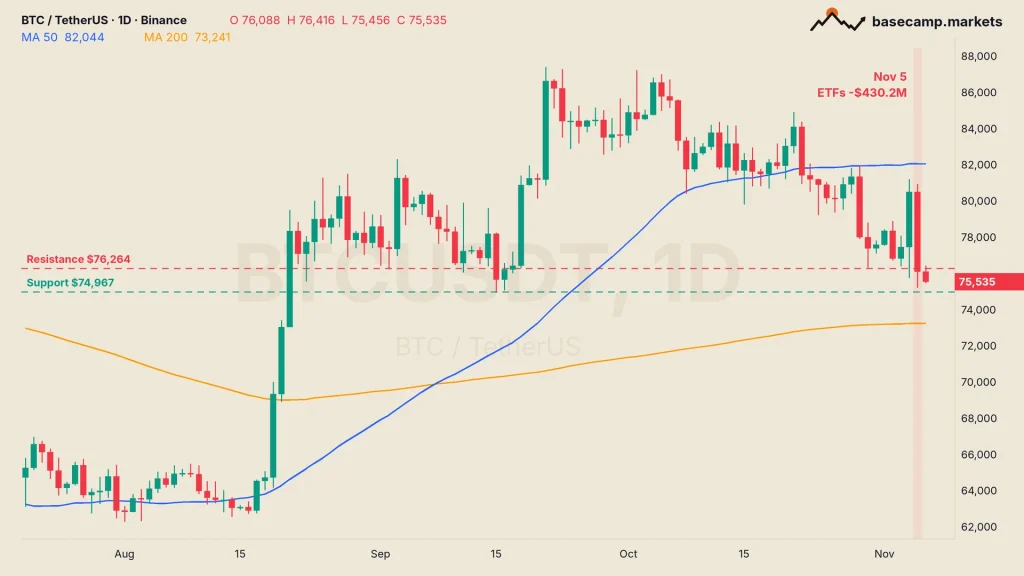
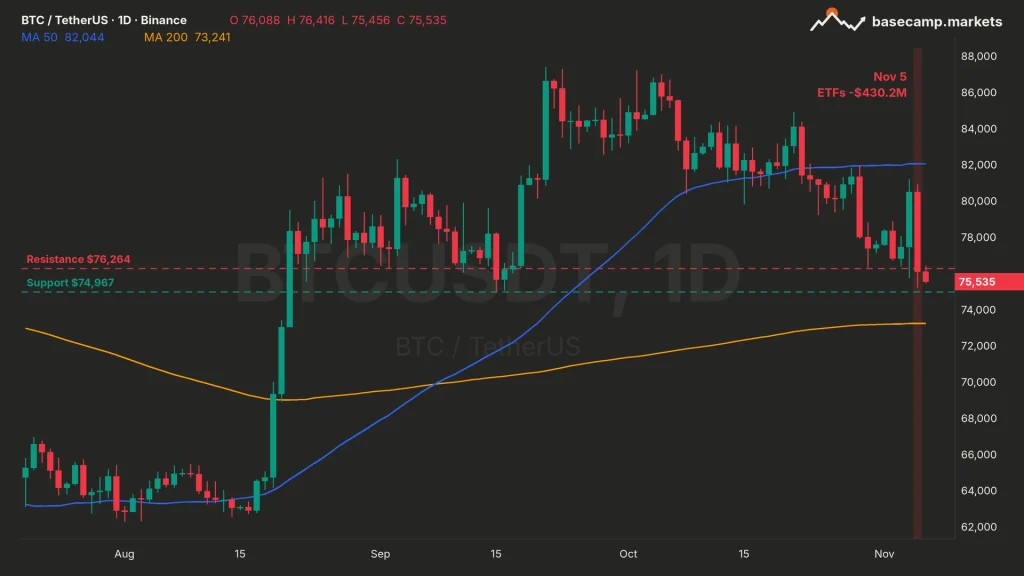
The BTC price is $75,535 at the time of writing. Thursday’s close took out support at $76,264, the level buyers defended on election night, so that line is now the first resistance. Below sits $74,967, September 15’s low; Thursday’s dip stopped at $75,208, just above it. Under that, the next marker is the 200-day moving average, the average close of the last 200 days, at $73,241. The 50-day is far above at $82,044.
A daily close back above $76,264 would say Thursday was a flush. A close under $74,967 would put the 200-day in play, and the ETF table suggests buyers aren’t in a rush to stop it.
TRAIL MAP: Ethereum ETF Outflows Hit $1.61B in October, Their Worst Month of 2026
One more detail from the table: twelve funds, zero green cells. Only one other session in this slide looked like that, the one that started it.

TANG has been trading crypto since 2017. The focus is technicals, DeFi and onchain data. On the chart, that means high-timeframe support, moving averages and momentum divergences. Onchain, it means regular checkups on where the data puts the cycle. TANG once ran CryptoJungle, a free community for researching and trading together, and brings that same spirit to Base Camp as one of its co-founders.
More from TANG