The short version
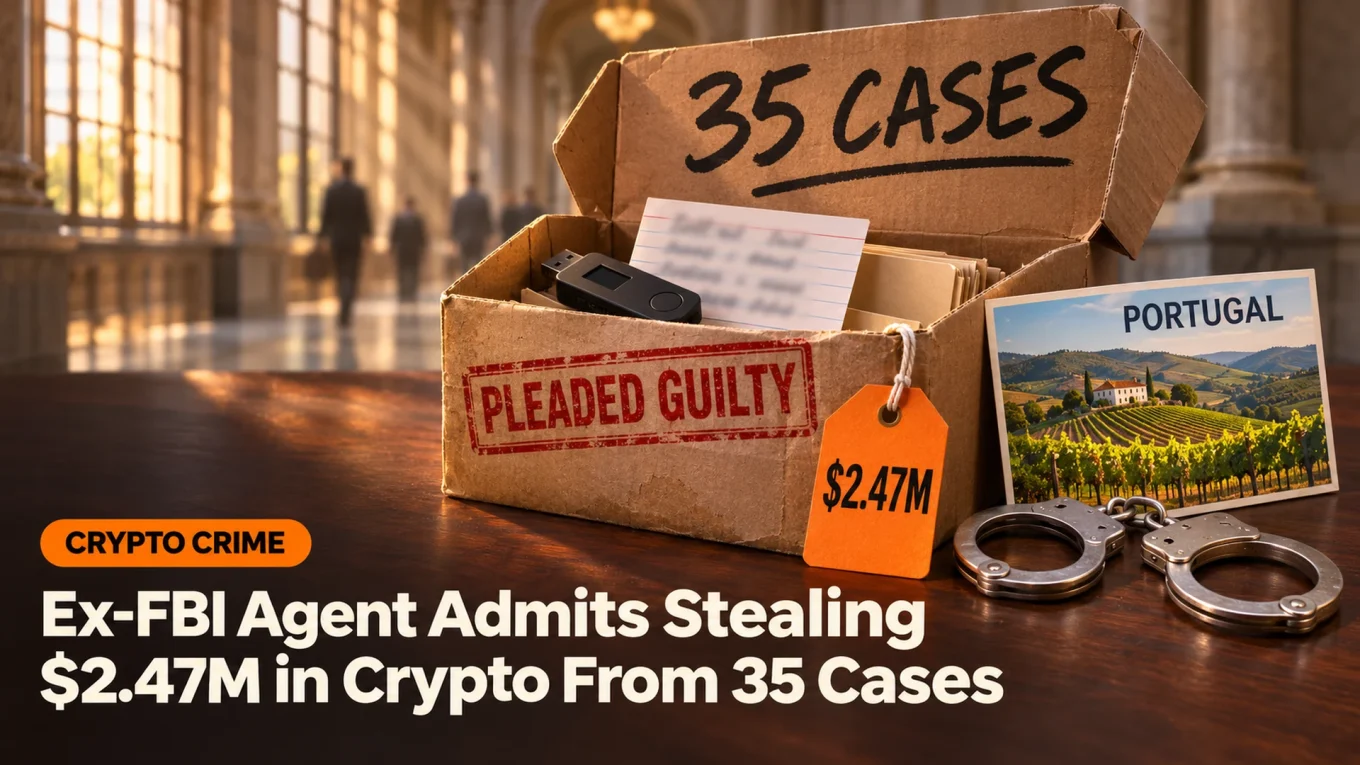
- FBI agent cryptocurrency theft: former agent Patrick Yaroch pleaded guilty to stealing about $2.47 million in crypto through roughly 100 transfers, using wallet keys from 35 FBI investigations.
- He memorized recovery phrases from FBI records, parked about $1 million in Suilend on Sui, and asked ChatGPT how to start a vineyard life in Portugal.
- The FBI has pulled back about $925,000 in crypto so far, and $93,082 had already gone on his credit cards, car and other debts.
- Next: sentencing on March 4, 2027, with up to 20 years in prison on the table.
“It was eating him up inside.” That is how a former FBI agent described his secret to a Justice Department colleague in July, before he walked into FBI headquarters and admitted he had been taking crypto from the wallets his own bureau was investigating.
This week the FBI agent cryptocurrency theft case reached a guilty plea. Patrick Steven Yaroch, 37, of Ashburn, Virginia, pleaded guilty to wire fraud and money laundering in federal court in Alexandria. Prosecutors say he made about 100 transfers worth roughly $2.47 million, using wallet credentials tied to 35 separate FBI investigations.

Former FBI Agent Admits Stealing $2.47M in Crypto Linked to 35 Investigations, Faces Up to 20 Years in Prison
Former FBI agent Patrick Steven Yaroch pleaded guilty to wire fraud and money laundering after stealing approximately $2.47 million in cryptocurrency through about 100
How Did the FBI Agent Cryptocurrency Theft Work?
He looked up the keys in FBI records. Yaroch worked on a national security squad in the FBI’s Boston office from 2017, focused on a country the court papers only call “Adversarial Nation State 1”, then moved to the Counterintelligence and Espionage Division at headquarters in February 2025. He held a top secret clearance the whole time.
According to the FBI affidavit filed on August 1, he got frustrated in late 2024 that the bureau “could not or would not act” against the crypto accounts he was watching. So he searched FBI holdings for their recovery phrases, memorized them and swept the funds into a personal wallet. When agents came to his house, he pulled a 3×5 card with the key words to his own wallets out of his FBI credentials.
Prosecutors say the thefts started no later than December 2024 and hit wallets of criminal suspects, nation-state actors and at least one wallet the FBI had set up for its own operation. When he was charged in August, he put the haul at under $1 million. The plea puts it at $2.47 million.
Sponsored · Affiliate link
Save 20% on fees trading on WEEX
Base Camp may earn a commission if you sign up. It never affects what we write.
Where Did the $2.47 Million Go?
Not very far. The affidavit traces most of it to the Sui blockchain and the Kraken app on his phone.
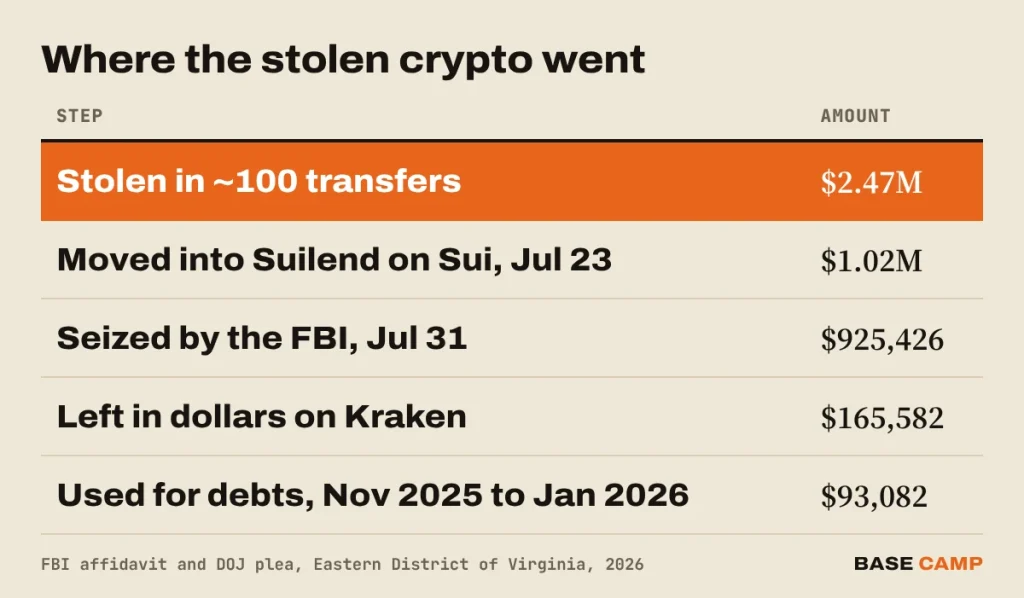
On July 23, a week before his arrest, he moved about $1.02 million into Suilend, a lending app on Sui, through the Slush wallet. He wanted interest, and he told agents he picked Suilend because he liked its water-droplet logo.
Some was already spent: about $93,082 went to credit cards, car payments and other debts between November 2025 and January 2026. On July 31 the FBI used seed phrases found in his house to move $925,426 into government wallets. Another $165,582 sat in plain dollars on Kraken.
SIDE TRAIL: Your First Crypto Wallet, Set Up Safely: Hot vs Cold and the Seed Phrase
What Was the Portugal Plan?
A vineyard. In June he asked ChatGPT what to do with “around $1 million” if he wanted to leave the U.S. for an EU country. The chatbot already knew he wanted a 2 to 5 hectare wine estate. Its answer: “Portugal (my top choice for your specific situation).”
He had given two Portuguese lawyers power of attorney to get him a local tax number and booked a family trip to Porto for September. He also flew to Germany, Portugal and Grenada this year without reporting it, against FBI security rules. He told agents he wasn’t planning to move money to Portugal. Prosecutors say the proceeds were meant to finance a new life abroad.
He never made the September flight. He was arrested at home on July 31 and fired the same day.
Has This Happened Before?
Yes. In 2015, two agents on the Silk Road case, Carl Force of the DEA and Shaun Bridges of the Secret Service, were sent to prison for stealing bitcoin during that investigation.
The lesson from this FBI agent cryptocurrency theft is older than any of them. A seed phrase is the wallet. Whoever reads it, a hacker, an exchange insider or an FBI agent with database access, can empty the account, and the blockchain does not ask who they work for.
TRAIL MAP: Protecting Your Crypto Accounts: 2FA, Passwords and Phishing
U.S. District Judge Patricia Tolliver Giles accepted his plea. She sentences him on March 4, 2027, and the charges carry up to 20 years in prison.

VikingXBT has been trading crypto since 2017. The focus is futures, onchain data and automation. Onchain flows get checked before a chart is trusted, and anything repetitive gets automated. VikingXBT built Base Camp's own onchain scanner, which flags bundlers, snipers, dev holdings and wallet clusters in one view, and backtests strategies before trading them.
More from VikingXBT