The short version
- Death Bets Act (S. 4035) passed the US Senate by voice vote on November 19, barring CFTC-registered prediction markets such as Kalshi and Polymarket US from war, terrorism, assassination and death contracts.
- Kalshi says it has never listed death markets, while Polymarket’s global exchange, out of the bill’s reach, has about $81 million in bets on a US invasion of Iran before 2027.
- Next: the House, where Rep. Mike Levin’s companion bill H.R. 7942 sits with the Agriculture Committee.
“These markets are operating in a Wild West, desperately in need of regulation and guardrails.” That was Sen. Adam Schiff on the Senate floor, and this time the Senate agreed with him.
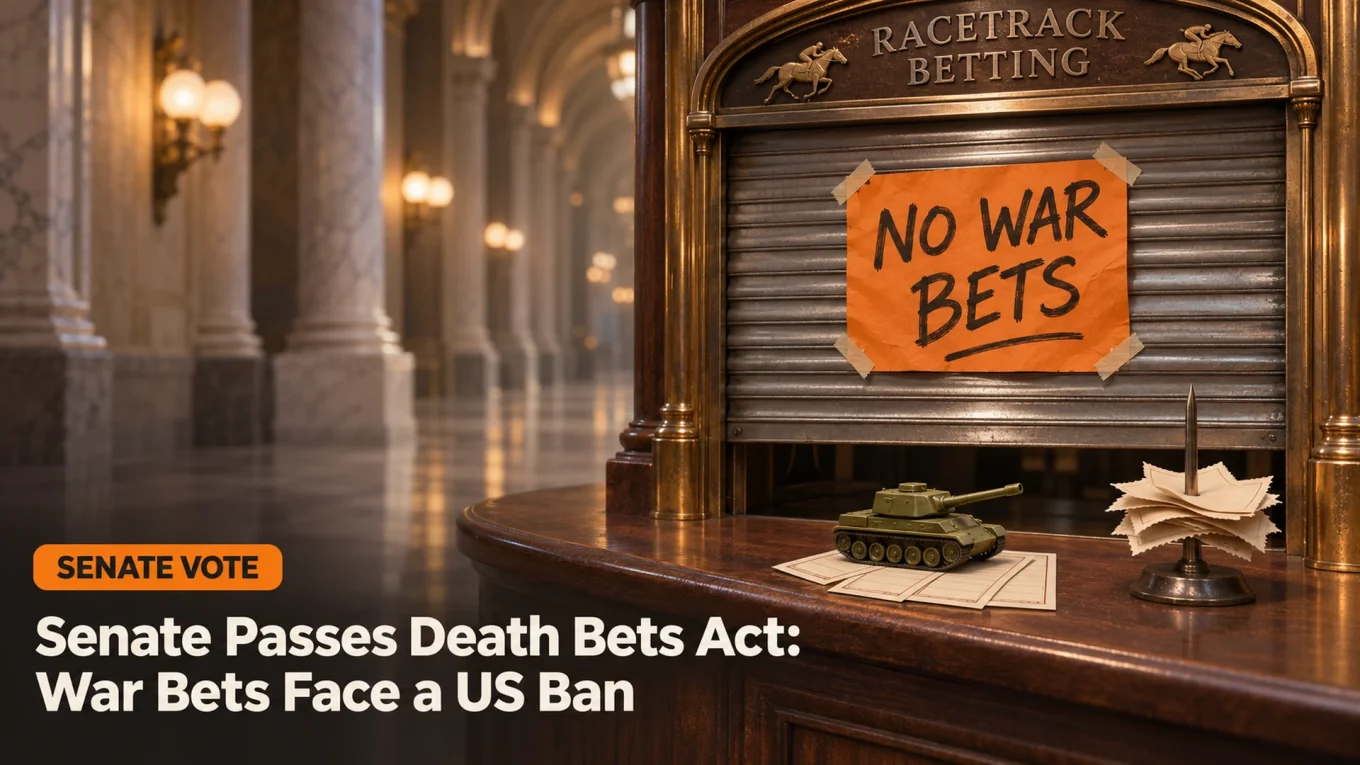
It passed the Death Bets Act on Thursday, November 19, on a voice vote with nobody objecting. The bill, S. 4035 from Schiff (D-Calif.) and Sen. John Curtis (R-Utah), would stop CFTC-registered prediction markets from listing or clearing contracts on terrorism, assassination, war, US military operations or a person’s death. That puts Kalshi and Polymarket’s US exchange in scope. Next stop: the House.
So what changes for traders? Less than the name suggests. The biggest war markets sit where this bill can’t reach.
Schiff posted the result the same night:

BREAKING: The Senate just passed my bill with @SenJohnCurtis to prohibit prediction markets from listing contracts involving terrorism, assassination, war, military operations, or an individual’s death.
With this bill, Congress is making it clear that these bets should be
What the Death Bets Act Bans
The name is an acronym: the Discouraging Exploitative Assassination, Tragedy, and Harm Betting in Event Trading Systems Act. It applies to every “registered entity” of the CFTC, the regulator for US futures and event contracts. In practice that means exchanges like Kalshi and the clearinghouses that settle their trades.
The Senate Press Gallery logged that S. 4035 passed together with a Schiff/Curtis amendment. The passed text also reaches contracts whose outcome depends mainly on someone dying, even when the wording never mentions death, Fortune reported.
Why a law at all? The CFTC can already block war, terrorism and assassination contracts it finds contrary to the public interest. Rep. Mike Levin, who carries the bill in the House, said in March that this left loopholes. The bill turns that agency power into a flat ban and adds death to the list.
Sponsored · Affiliate link
Save 20% on fees trading on WEEX
Base Camp may earn a commission if you sign up. It never affects what we write.
Kalshi Says It Never Listed Death Markets
Kalshi isn’t fighting this one. “Kalshi has never listed death markets,” a spokesperson told Fortune, and CEO Tarek Mansour wrote in February that the exchange doesn’t list markets “directly tied to death.”
Iran was the test case. Fortune reported that Kalshi refused to pay out on a market about Supreme Leader Ali Khamenei after his killing, pointing to a rule that excluded death as an outcome. Levin’s office put trading on that market at $54 million before Kalshi paused it. Polymarket declined to comment to Fortune.
Curtis, the Republican half of the bill, kept his case short:

There should be no financial incentive to profit from terrorism, war, or the loss of human life. Glad to see the DEATH BETS Act, our bipartisan legislation to prohibit prediction market contracts on these outcomes, pass the Senate with unanimous consent!
SIDE TRAIL: Kalshi Geofencing: Schiff and 8 Senators Tell CFTC’s Selig to Let States Block Prediction Markets
Polymarket’s Biggest War Markets Sit Offshore
Here’s the catch. Polymarket runs two venues: a US exchange registered with the CFTC, and the original global exchange, which is closed to US users. The Death Bets Act only reaches the first.
The global site is where the war money is. Its “Will the U.S. invade Iran before 2027?” market has taken about $81 million in bets since it opened in November 2025, and traders price the odds at 7% at the time of writing. A US statute aimed at CFTC-registered venues doesn’t touch it.
In other words, the bill takes war bets off the US-regulated venues while the global one stays open.
What Comes Next in the House?
A House vote on its own version, and then one shared text. Levin filed H.R. 7942 on March 17, and it sits with the House Agriculture Committee. Its March wording is broader than the Senate’s, so the two chambers have to settle on one version before anything reaches the president.
Fortune calls it the first prediction market bill to clear either chamber of Congress. Schiff and Curtis also back a separate bill that would ban sports and casino-style contracts on federally regulated exchanges, a much bigger fight for Kalshi. For the war bets, the House Agriculture Committee decides what happens next.

TANG has been trading crypto since 2017. The focus is technicals, DeFi and onchain data. On the chart, that means high-timeframe support, moving averages and momentum divergences. Onchain, it means regular checkups on where the data puts the cycle. TANG once ran CryptoJungle, a free community for researching and trading together, and brings that same spirit to Base Camp as one of its co-founders.
More from TANG