The short version
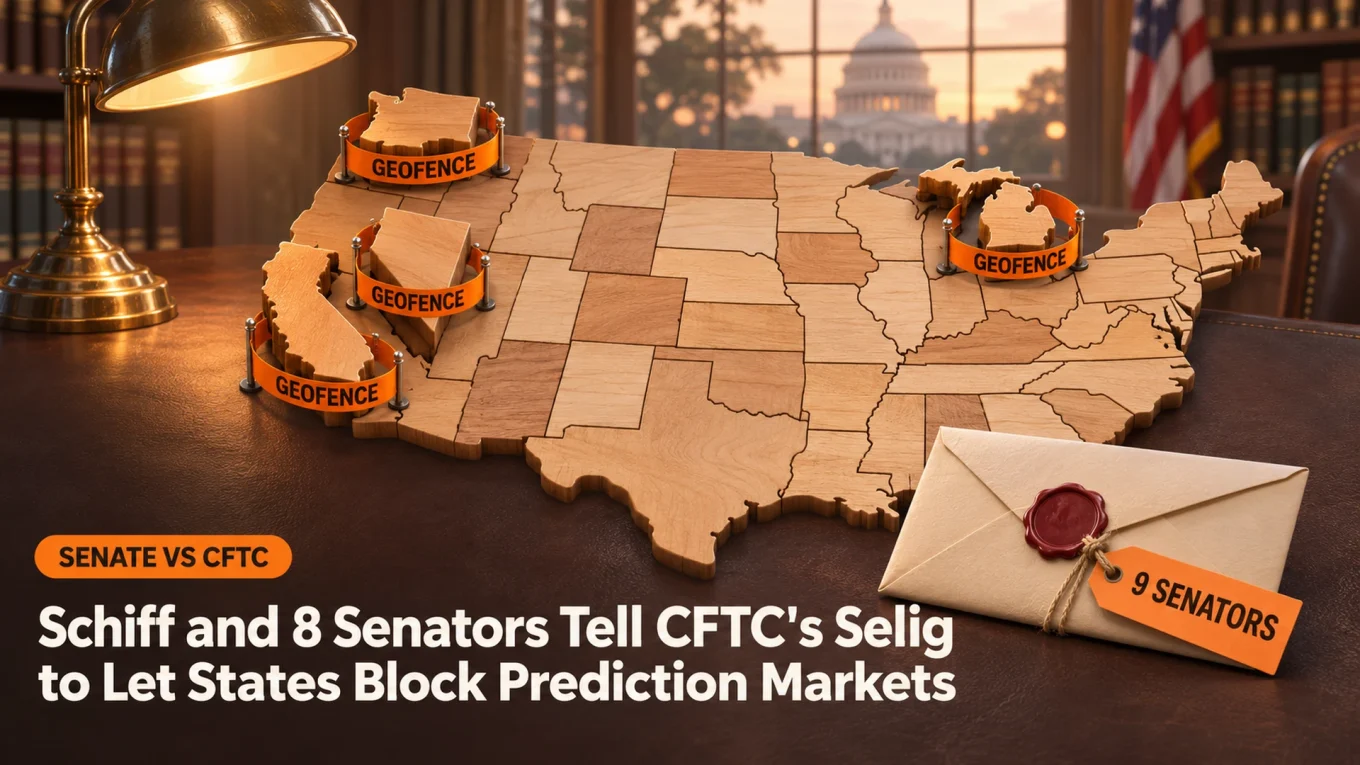
- Kalshi geofencing: Adam Schiff and eight Democratic senators asked CFTC Chair Mike Selig on November 16 to withdraw his ban on state-by-state blocks.
- They say the November 5 interpretation clashes with active court orders in California, Michigan, Nevada and Washington and a 3-0 Ninth Circuit ruling for California tribes.
- Next: the senators want the CFTC to confirm by November 23 that it is keeping its prediction market records, and the exchanges’ 30 days run out on December 5.
“Lawless.” That is the word Senator Adam Schiff chose for the CFTC’s newest move in the prediction market fight.
On Monday, November 16, Schiff and eight other Democratic senators wrote to CFTC Chairman Mike Selig and asked him to withdraw the interpretation that bans Kalshi geofencing. Geofencing is how Kalshi, Polymarket and the other exchanges switch off contracts for users in a state where a court or regulator has said no. The CFTC now says those state-by-state blocks break federal rules.
So which order wins when a federal regulator and a state judge say opposite things?
Schiff announced the letter on X, and the senators’ push was first reported by The Wall Street Journal:

The @CFTC wants prediction markets to offer contracts in all 50 states and Tribal lands – in violation of state and federal law, court orders, and Tribal sovereignty.
I'm leading my Senate colleagues in demanding that Chairman Selig reverse this lawless decision.
What Does the CFTC’s Kalshi Geofencing Ban Say?
It told exchanges to stop blocking users by location. The CFTC’s Impartial Access Requirements interpretation reads Regulation 38.151(b), the rule that a designated contract market must give fair and open access to its members, as a ban on domestic geographic restrictions.
Selig put it plainly. “Derivatives markets must operate on a uniform basis at a national scale,” he said, and “geographic access restrictions are inconsistent with those purposes.”
Exchanges get 30 days to drop the restrictions or explain to the CFTC’s Division of Market Oversight why they can’t. The brokers routing trades to them can’t keep the fences up either. Counting from November 5, that window closes on December 5.
In practice, that means sports contracts everywhere, including the places where courts have ordered them blocked.
Sponsored · Affiliate link
Save 20% on fees trading on WEEX
Base Camp may earn a commission if you sign up. It never affects what we write.
Why the Senators Say the CFTC Is Defying the Courts
The letter is blunt. “Your unilateral decision directly conflicts with active court orders, undermines state and tribal law, and must be reversed,” the senators wrote.
Those orders are active in California, Michigan, Nevada and Washington, and the signatures match the map. Alongside Schiff are Alex Padilla of California, Catherine Cortez Masto and Jacky Rosen of Nevada, Maria Cantwell and Patty Murray of Washington, Elissa Slotkin and Gary Peters of Michigan, and Amy Klobuchar of Minnesota, the top Democrat on the Senate Agriculture Committee, which oversees the CFTC.
Nevada gaming reporter Howard Stutz pointed straight at his own state’s case:

Exclusive: Nine Democratic senators ask CFTC not to interfere with state bans on prediction markets
State and federal courts in Nevada ordered Kalshi to stop offering sports betting. The 9th Circuit agreed.
via @WSJ
wsj.com/livecoverage/s…
The tribes are the sharpest point. On September 16, the Ninth Circuit ruled 3-0 in Blue Lake Rancheria v. Kalshi that the tribes are likely to win their claim that Kalshi’s sports contracts are unauthorized Class III gaming when users trade from tribal land. Federal gaming law for tribes still applies, the court said, whatever the Commodity Exchange Act says about exclusive jurisdiction.
The senators go further than policy. They say the CFTC appears to be “encouraging prediction markets to offer prohibited contracts in contempt of these court orders,” and they raise the question of whether the agency is coordinating with platforms it sides with in court. Their ask on Kalshi geofencing is short: “The Commission must withdraw the interpretation or freeze all efforts to implement until litigation is resolved.”
They also want the CFTC to keep every record on prediction markets from January 1, 2025 onward, and to confirm by November 23 that it is doing so.
SIDE TRAIL: Kalshi Louisiana Ban: Court Order Blocks Kalshi, Polymarket, Coinbase and Robinhood as the CFTC Sues
Selig Is Suing the States Instead
The letter is unlikely to move him. In the states vs CFTC prediction markets fight, Selig has picked lawsuits over letters: the agency sued Utah on October 27, then Arkansas and Louisiana on November 13. Louisiana was its 12th state lawsuit to defend what it calls its exclusive jurisdiction over derivatives markets.
That leaves Kalshi and Polymarket in the middle. Their regulator tells them to switch the fences off, while judges in four states and a federal appeals court have ruled the other way.
Whichever they pick, somebody with power over them will say they broke the rules.

TheCryptoMonk has been trading since 2017 and reads the market from the top down. The focus is macro and the high timeframes: where stocks, rates and liquidity are heading, and what the weekly and monthly charts say about Bitcoin. Short-term noise matters less than the bigger trend.
More from TheCryptoMonk