The short version
- MEXC FinCEN order: Treasury has barred US financial institutions from moving any funds to or from MEXC Global, citing at least $16 billion in illicit flows from May 2021 to May 2026.
- That includes nearly $1.5 billion tied to Russian sanctions evasion and about $1 billion with more than 40 Iranian crypto exchanges; MEXC says it operates normally and has started an independent review.
- Next: the ban takes effect 30 days after the order is published in the Federal Register, which had not happened by Saturday morning.
$16 billion is the number behind the MEXC FinCEN order that landed on Friday evening. The order doesn’t fine the exchange or freeze a wallet. It does something slower and arguably worse: from 30 days after it is published in the Federal Register, no US bank or payment firm may send money to MEXC Global or take money from it.
Treasury’s case, in short:
- At least $16 billion of illicit flows between May 2021 and May 2026, nearly $1.5 billion of it linked to Russian sanctions evasion, the legal hook for the order.
- About $1 billion in direct transactions with more than 40 Iranian crypto exchanges.
Treasury posted the action late on Friday as part of its Iran campaign, Operation Economic Outcast:

Today, as part of Operation Economic Outcast, Treasury’s Office of Foreign Assets Control designated eight money services businesses based in Canada that enable the Iranian regime.
Additionally, @FinCENnews issued an order effectively cutting off MEXC Global’s access to the
What Does the MEXC FinCEN Order Actually Ban?
Money moving between the US financial system and MEXC Global. The order, issued under section 9714(a) of the Combating Russian Money Laundering Act, bars US financial institutions from “any transmittal of funds from or to MEXC Global”, and breaking it can bring civil or criminal penalties, Treasury said.
That is not an OFAC sanctions listing. MEXC’s assets aren’t blocked and nobody is barred from holding a MEXC account. Instead the exchange loses its connection to US dollars through banks, card processors and other money transmitters, which under the Bank Secrecy Act include US-registered crypto platforms. FinCEN used the same law against the Russian exchange Bitzlato in January 2023.
The clock hasn’t started yet. The order takes effect 30 days after it appears in the Federal Register, and it was not there when we checked on Saturday morning.
Sponsored · Affiliate link
Save 20% on fees trading on WEEX
Base Camp may earn a commission if you sign up. It never affects what we write.
Where Treasury Says the $16 Billion Went
MEXC was founded in 2018, handled more than $1 billion a day as of September and held about $5 billion in reserves, according to Treasury, which counts it among the 20 biggest crypto exchanges in the world. Its own rules ban users in Iran and North Korea. Treasury says “severe deficiencies” in its anti-money laundering controls let those users through anyway.
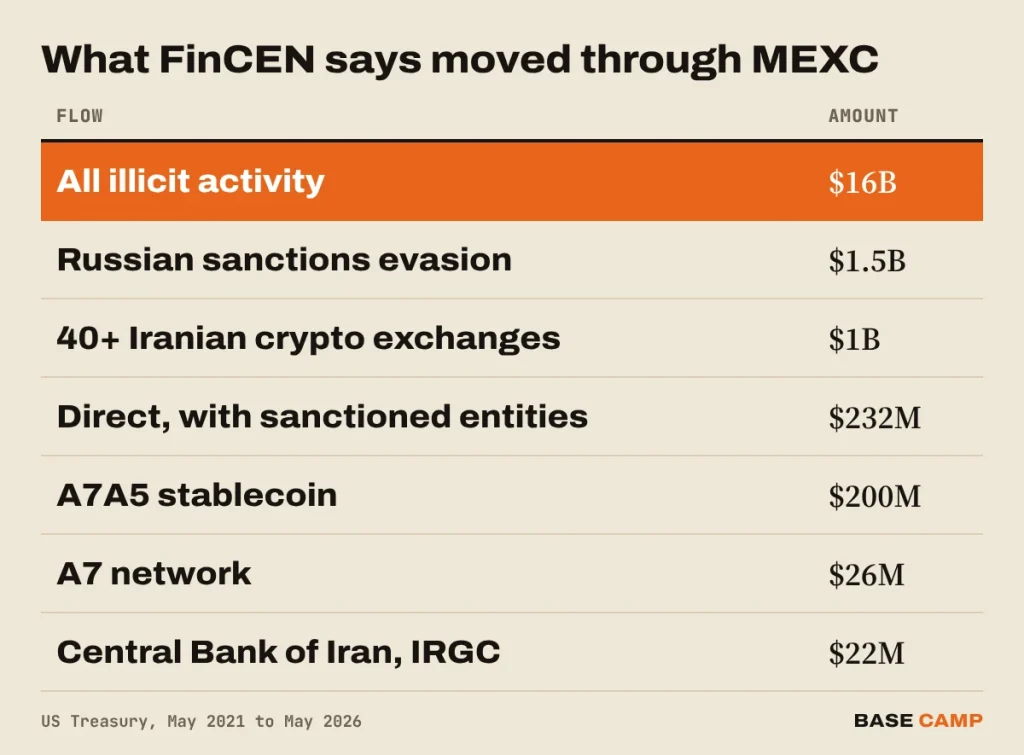
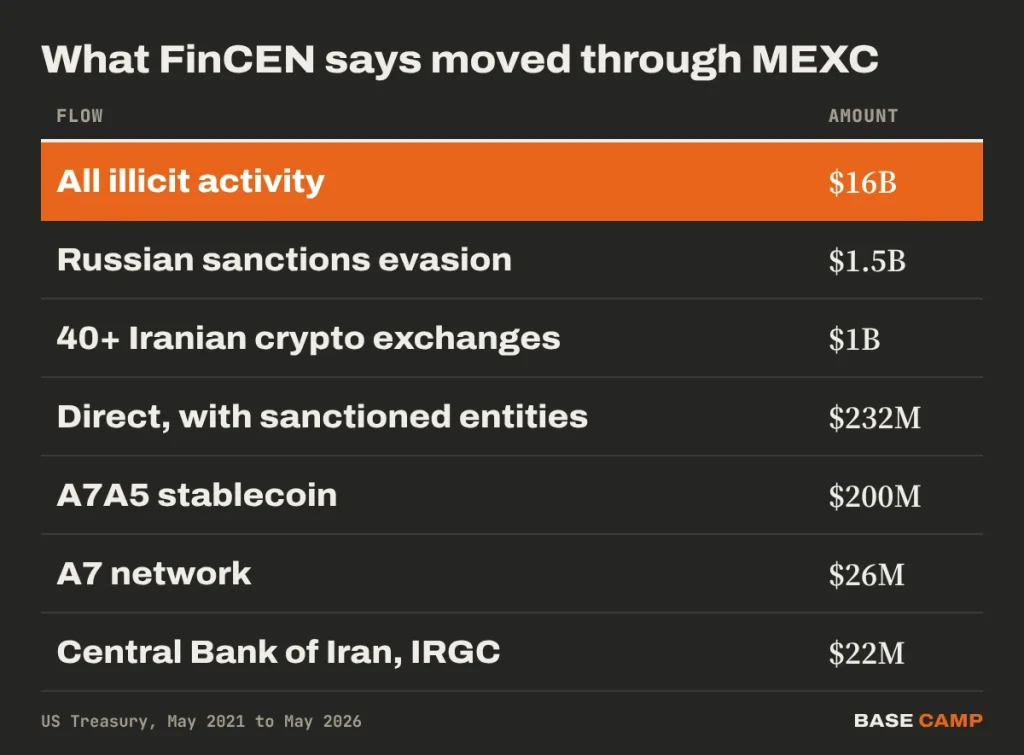
The detail that stands out is timing. MEXC was still processing transactions with Garantex, the Russian exchange sanctioned in April 2022, and its successor Grinex as recently as June 2026. It also handled almost $200 million connected to A7A5, the stablecoin pegged to the rouble that Treasury says the A7 network uses to help clients dodge sanctions.
SIDE TRAIL: Can Crypto Be Frozen? Who Froze $2.7B of the Binance Hack, and Why $2.4B Got Away
Is MEXC Safe? What the Exchange Says
The MEXC exchange said early on Saturday that it is reviewing the order with its legal and compliance team, that the platform is operating normally and that user assets are safe. It has started an independent review of its anti-money laundering and sanctions controls and plans to talk to FinCEN and other regulators.
The first market reaction came from token issuers, not traders. Reserve, the platform behind the LCAP and CMC20 index tokens, said it and its market makers will stop providing liquidity for both on MEXC and withdraw the funds. Expect more projects with US ties to do the same over the next 30 days, since a market maker that can’t move dollars in or out has little reason to stay.
MEXC was already shrinking its map. On October 20 it said it would stop serving users in Russia and Belarus, and it is winding down accounts in the Netherlands. Its MX token trades at $1.50 at the time of writing, down 4% in 24 hours and 21% in a month.
Officially, US residents were never supposed to be on MEXC. The MEXC FinCEN order makes that rule stick from the other side: even a US bank or crypto app asked to send a wire or a withdrawal there will have to say no. It is also a reminder of why the exchange you pick matters as much as the coins you buy there.
TRAIL MAP: How to Buy Your First Crypto: Exchanges, Fees and KYC Without the Headaches
Treasury’s own summary of the choice fits in one line, from Secretary Scott Bessent: “Either you support the Iranian regime, or you have access to the U.S. financial system.”

TANG has been trading crypto since 2017. The focus is technicals, DeFi and onchain data. On the chart, that means high-timeframe support, moving averages and momentum divergences. Onchain, it means regular checkups on where the data puts the cycle. TANG once ran CryptoJungle, a free community for researching and trading together, and brings that same spirit to Base Camp as one of its co-founders.
More from TANG