
The short version
- A trade plan is a short document that says what you trade, when you enter, where you exit and how much you risk.
- It moves decisions to before the trade, when you’re calm, instead of during it, when you’re not.
- Keep it to one page: markets, timeframes, one or two setups, risk rules, trade management and a routine.
- Review it monthly with your journal. Change the plan on the weekend, never in the middle of a trade.
Most traders don’t have a plan. They have a feeling, a chart and a “buy” button. That works until the market does something unexpected, and then every decision is made with your heart rate at 140.
A trade plan fixes that. It’s not a long business document. It’s one page of rules you write while calm, so that when the market isn’t, you already know what to do. This guide gives you a template and shows you how to fill it in.
Why you need one
Without a plan, every trade is a new decision. Should I buy? How much? Where’s my stop? Should I take profit or hold? Each of those questions is a chance for fear and greed to vote.
A plan does three things:
- It removes decisions in the moment. The rule decides, not your mood.
- It makes you consistent. If you trade the same way every time, your results start to mean something.
- It makes you testable. You can’t improve “I trade by feel.” You can improve “I buy retests of daily support with a 1:2 minimum.”
Part 1: Your why and your capital
Start with the basics:
- Why are you trading? Extra income, growing a small account, learning? Be honest. It changes how much risk makes sense.
- Trading capital: the exact amount you set aside for trading. Separate from savings and long-term holdings, ideally in a separate account.
- What happens if it’s gone? If losing it all would hurt your life, the amount is too big.
Part 2: Markets and timeframes
Narrow it down. Trying to trade everything is a fast way to trade nothing well.
- Markets: for example, BTC and ETH only, or BTC plus three liquid altcoins. Avoid coins with thin liquidity where your stop can slip badly.
- Spot or derivatives: spot only to start is a perfectly good answer. If futures, set a maximum leverage.
- Timeframes: one higher timeframe for direction (say, daily), one for setups (4h) and one for entries (1h). More on this in Multi-timeframe analysis.
- When you trade: your available hours. Swing trading on the 4h and daily fits around a full-time job. Scalping the 1-minute chart doesn’t.
Part 3: Your setups
A setup is a specific situation you trade, described clearly enough that two people would agree whether it’s there. Start with one or two. Example:
Setup: support retest in an uptrend
- Context: daily chart making higher highs and higher lows, price above the 200-day moving average.
- Location: price pulls back to a clear daily support or a broken resistance being retested.
- Trigger: on the 4h chart, a candle closes back above the level after wicking below it.
- Stop: below the wick low.
- Target: the last swing high, as long as it gives at least 1:2.
- Skip if: big news is due within 24 hours, or the target sits behind a major resistance.
Notice how specific that is. “Buy the dip” isn’t a setup. This is.
Part 4: Risk rules
Copy these from Risk management: the 1% rule and Risk/reward, with your own numbers:
- Maximum risk per trade (e.g. 1% of trading capital).
- Minimum risk/reward (e.g. 1:2 to the first target).
- Maximum open trades or total open risk (e.g. 3%).
- Daily loss limit (e.g. stop for the day after −2%).
- Weekly or monthly limit (e.g. after −6% in a month, cut size in half until you’re back).
- Maximum leverage, if you use futures.
Part 5: Managing the trade
Most plans stop at the entry. The money is made or lost after it. Decide:
- When you move the stop to break-even (e.g. once price reaches +1R).
- How you take profit: all at the target, or partly at +1R or +2R and the rest with a trailing stop.
- When you exit early: for example, if the setup’s reason disappears (a daily close back below the level), even if the stop wasn’t hit.
- What you never do: widen a stop, add to a losing position, remove a stop “for a minute.”
Part 6: Your routine
Habits beat willpower. A simple routine:
- Before the session: check the higher timeframe, mark key levels, check the news calendar (rate decisions, CPI, big token unlocks).
- Before every trade: run the before every trade checklist on our Tools page.
- After every trade: log it in your journal with a screenshot.
- Weekly: review the week’s trades. Did you follow the plan?
- Monthly: review the numbers and decide if anything in the plan should change.
The one-page template
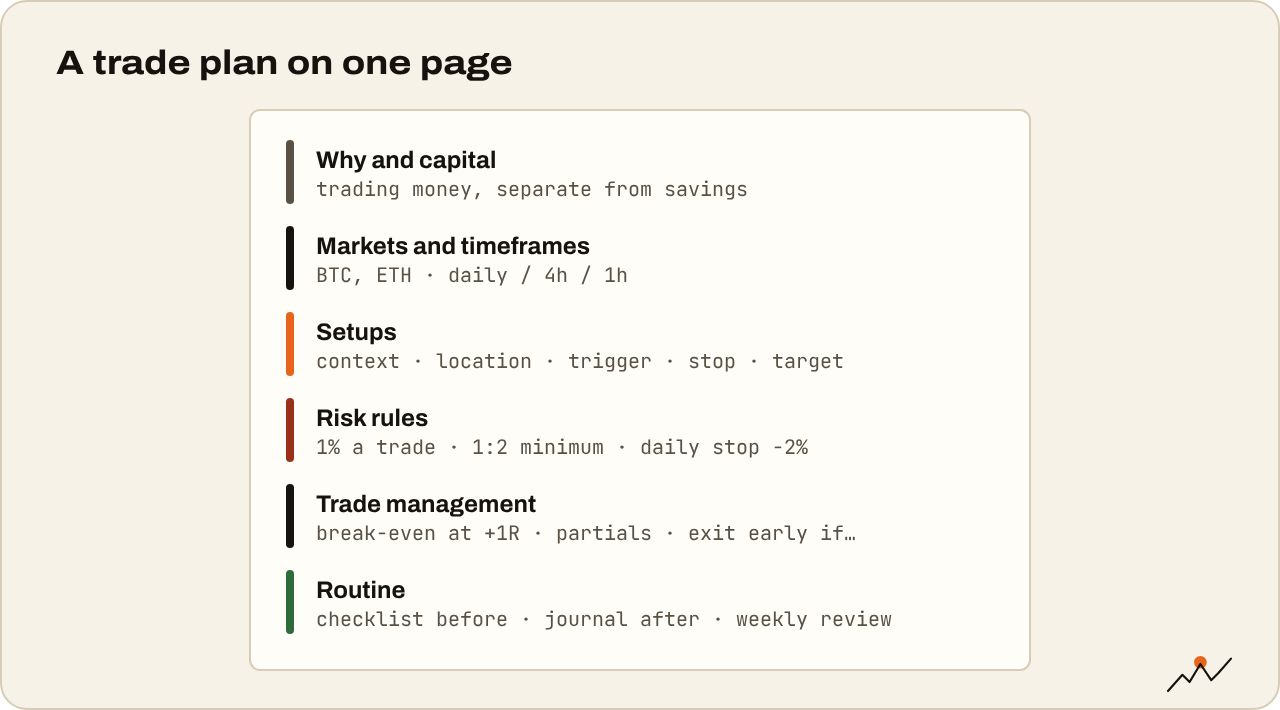
Copy this into a note and fill it in:
- Why I trade, and my trading capital: …
- Markets: … Spot / futures (max leverage): …
- Timeframes: direction … setups … entries …
- Setup 1: context … location … trigger … stop … target … skip if …
- Setup 2 (optional): …
- Risk: per trade …% · min R:R 1:… · max open risk …% · daily stop …% · monthly stop …%
- Trade management: break-even at … · partials at … · exit early if …
- Never: widen stops · add to losers · trade after hitting my daily limit
- Routine: pre-session … · checklist before every trade · journal after every trade · weekly and monthly review
Print it or pin it next to your screen. Seriously. A plan you can’t see while trading is a plan you won’t follow.
Keeping the plan alive
- Change it on the weekend, with your journal open, never in the middle of a trade because one went badly.
- Change one thing at a time, so you know what made the difference.
- Give changes time. Twenty trades is not enough data to judge a setup. Fifty to a hundred starts to be.
- Write down every rule you break, and what it cost. That list is usually the best lesson you’ll get.
Tip. CryptoCred’s Trade Management and Entry Triggers go deeper on the two parts of the plan most people leave vague.
Where to go next
A plan is only as good as the feedback you get on it. Next: Keeping a trading journal.