The short version
- Gnosis Pay says an attacker got into the system behind its own branded cards on November 3; customer funds and its partner-card platform were not affected.
- Leaked data can link a cardholder’s name and home address to a card number and every wallet address on the account, making targeted scams far more convincing.
- Next: the breached system shuts down for good on December 20; until then 3D Secure is mandatory for every online card payment.
Your coins can be safe and your privacy still gone. That is the short read on the Gnosis Pay data breach.
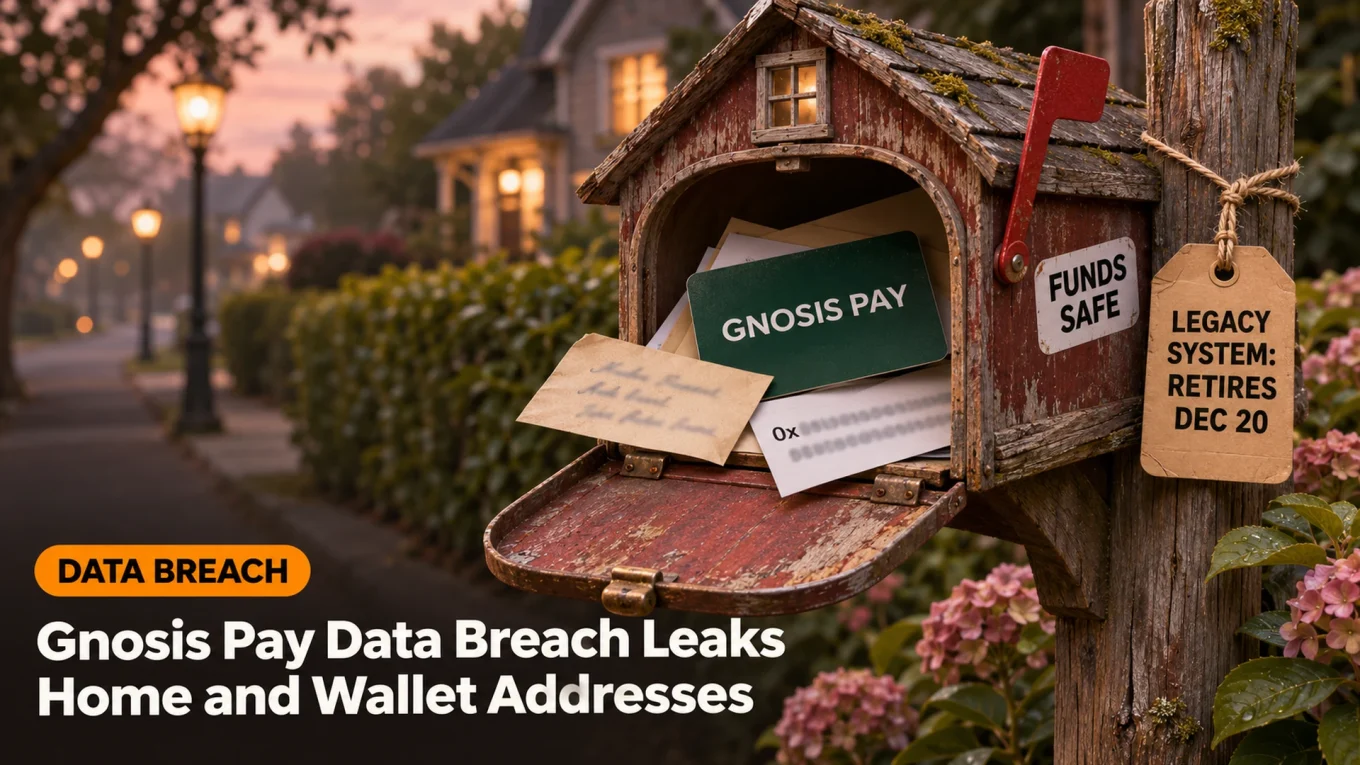
The crypto card company says someone got into the system behind its own branded cards on November 3. No funds moved. But one well-known customer says the company’s email listed a name, full home address, card number and every wallet address tied to the account.
Put those together and a stranger knows who you are, where you live and what you hold. So what was taken, and what should Gnosis Pay card holders do now?
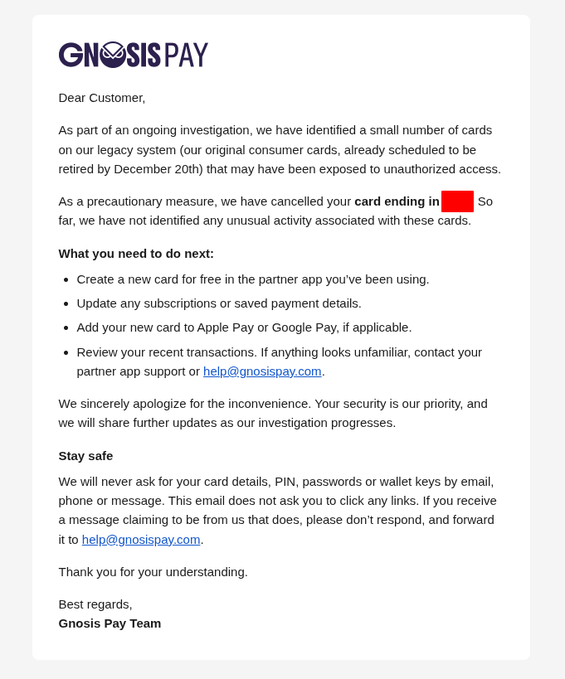
Lefteris Karapetsas, the founder of the rotki portfolio app, shared what the company told him on Friday:

At this point I really don't know what to say @gnosispay
– Full home, name and address details
– Card number
– All wallet addresses linked to the account
Extremely disappointed. You had already lost me as a user but you could have at least protected my data ….
Damn shame,
What Did Gnosis Pay Say About the Breach?
The company confirmed the breach in a blog post on Friday, November 6. The plain facts:
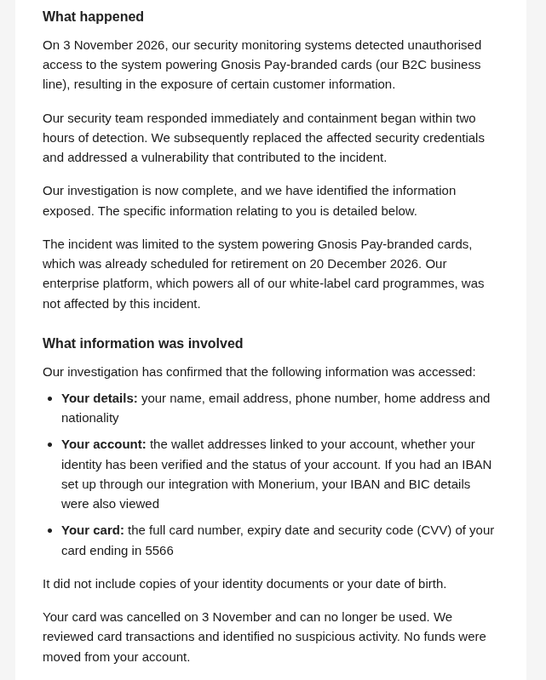
- Its monitoring caught unauthorized access on November 3, and containment started within two hours.
- Only the older system behind its own branded cards, the direct-to-consumer business, was hit.
- The enterprise platform that runs partner cards was not affected, and neither were customer funds.
- That older system was already due to shut down on December 20, 2026.
Wu Blockchain picked up the notice within the hour:

Gnosis Pay Confirms Customer Data Exposure Following Unauthorized System Access
Crypto payment card provider Gnosis Pay disclosed that unauthorized access to its legacy B2C card system was detected on November 3, exposing some customer information. The company began containment
The company replaced the stolen credentials and fixed the hole. It has made 3D Secure, the extra check your bank app asks for during an online purchase, mandatory for every online card payment until the shutdown. It also stepped up monitoring of cards and wallets for fraud.
Every affected customer got an email listing exactly what was taken from their account. The company has not said how many people that is. It has told its partners, its card issuer and the data protection authorities, and apologized: “While funds were not affected, we recognise that the security of personal information is just as important.”
Sponsored · Affiliate link
Save 20% on fees trading on WEEX
Base Camp may earn a commission if you sign up. It never affects what we write.
Why Wallet Addresses Make This Worse
A leaked email address gets you spam. A leaked wallet address gets you a price tag.
It is a self-custody card: you spend from your own wallet on Gnosis Chain. Anyone can look up a public address and see its balance and history. Until now, nobody could easily match those addresses to a name. Now someone can, for some cardholders, with a home address attached.
That opens two doors. The first is phishing that sounds real: a fake support email that quotes your actual card purchase. The second is worse. People with known crypto balances and known addresses have been targeted at home before.
SIDE TRAIL: Keystone Wallet Breach: Maker to Destroy 18,835 Devices After Key Theft
A Second Incident in Five Months
This is not the first bad week for the company this year. In the June 1 Gnosis Pay hack, an attacker abused a bug in the wallet modules behind the cards and took about $1.5 million, with another $300,000 left stuck, across 5,281 wallets. Gnosis covered the losses and restored every balance, its post-mortem says.
The consumer card was on its way out anyway. In September, the company said it would wind down its own cards and web app and move users to partner apps such as Rebind and MiniPay, which run on the new platform. Karapetsas had already put it drily on Tuesday, November 3: “Gnosis Pay is the gift that keeps on giving … problems.”

December 20th, November 3rd. What's the difference?
Gnosis Pay is the gift that keeps on giving … problems 😐
GNO, the Gnosis token, barely moved on the news. It trades around $113.70 at the time of writing, down 0.9% over 24 hours.
What Cardholders Should Do Now
Read the company’s email first. It says what was taken from your account. Then:
- Treat every message about your card as fake until you check it yourself in the official app.
- Never share your seed phrase, private keys, PIN or full card number. Real support never asks.
- Ignore anyone asking you to “re-verify” your identity.
- If your wallet addresses were listed, think about moving savings to a fresh wallet that was never linked to the card.
- Don’t post about your holdings, online or at the pub.
TRAIL MAP: Protecting Your Crypto Accounts: 2FA, Passwords and Phishing
Worried customers can write to [email protected].
One rule covers most of it. The company says it will never ask you to move funds by email, text or phone. Anyone who does isn’t Gnosis Pay.

TheCryptoMonk has been trading since 2017 and reads the market from the top down. The focus is macro and the high timeframes: where stocks, rates and liquidity are heading, and what the weekly and monthly charts say about Bitcoin. Short-term noise matters less than the bigger trend.
More from TheCryptoMonk