The short version
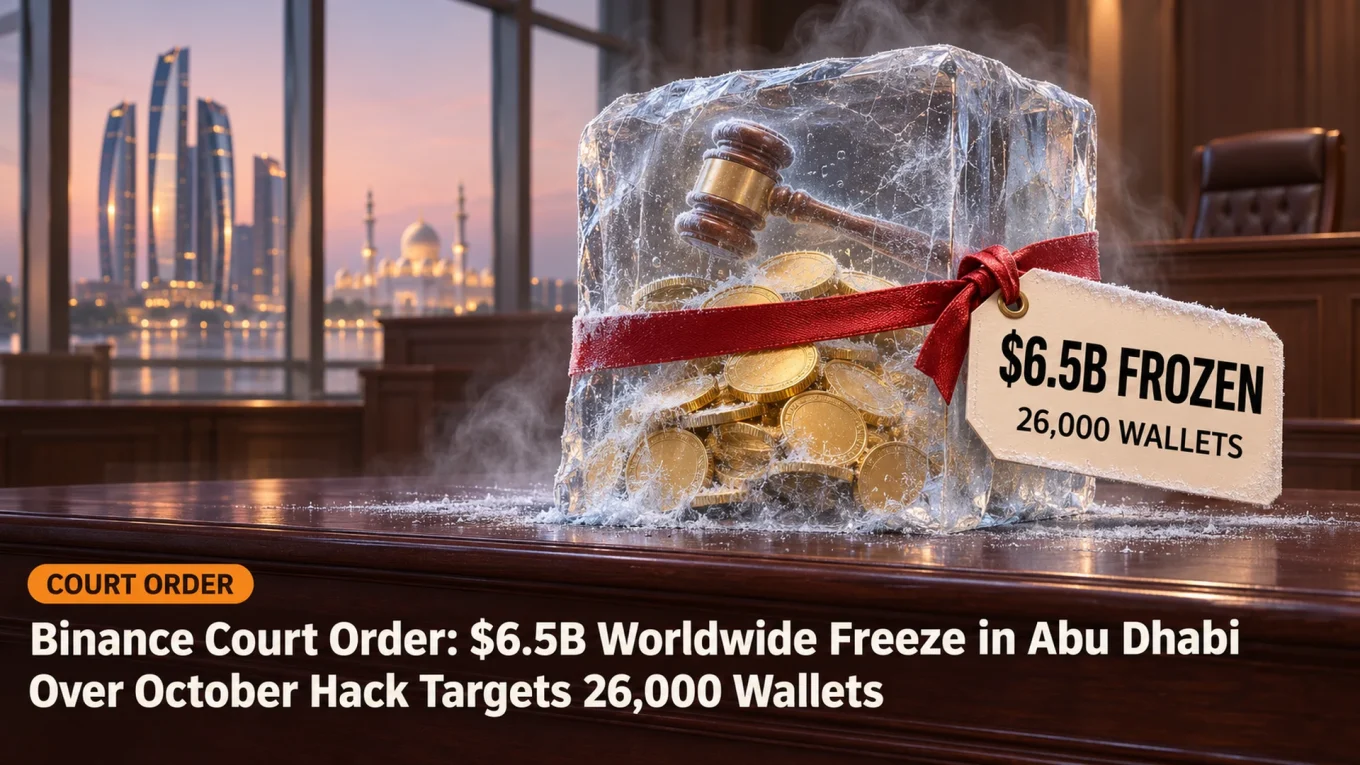
- Binance court order: the ADGM Courts in Abu Dhabi granted a $6.5 billion worldwide freezing injunction against the unknown people behind the October 29 hack.
- The orders can be served through the blockchain, with notice of a living list of 26,000 wallet addresses that Binance says hold stolen assets.
- The $6.5 billion is the cap on the freeze, not money recovered: Binance last counted about $2.85 billion of the $6.34 billion taken as frozen or intercepted.
Binance has won a worldwide freezing order in Abu Dhabi worth up to $6.5 billion, aimed at the unknown attackers behind the October 29 Binance hack. The Abu Dhabi Global Market (ADGM) Courts granted the injunction, and it comes with a twist: it can be served through the blockchain itself.
The target list is long. Binance’s lawyers say 26,000 wallet addresses hold stolen assets, and that list keeps changing as the money moves. So what can a Binance court order in Abu Dhabi actually do against hackers nobody can name?
Bloomberg summed up the order on X early on Thursday, November 19 (UTC):

Binance said it obtained a $6.5 billion freezing order from an Abu Dhabi court as the cryptocurrency exchange seeks to recover assets stolen in a massive hack last month bloomberg.com/news/articles/…
What the Binance Court Order Covers
Binance said on November 18 that it has been granted a court order in the ADGM Courts “to support the recovery of assets connected to the incident.” The main piece is a worldwide freezing injunction against “persons unknown, being the perpetrators of the fraud.”
There is more than one order. Binance also holds interim proprietary orders over specific stolen assets, some aimed at named defendants who already hold frozen funds. Binance alleges no wrongdoing by them and hasn’t named them.
Then the unusual part. The orders can be served via the blockchain, and the market gets notice of a “living list” of 26,000 wallet addresses. Kendall Day of Gibson Dunn, the law firm acting for Binance, didn’t undersell it:
“This $6.5 billion mega-injunction is one of, if not the, largest publicly known freezing orders ever made.”
The $6.5 billion is the cap on what the order can freeze. It is not money recovered.
Sponsored · Affiliate link
Save 20% on fees trading on WEEX
Base Camp may earn a commission if you sign up. It never affects what we write.
How Much of the Binance Hack Is Already Frozen?
About $2.85 billion, by Binance’s last count. Its initial findings from November 3 put the assets hit at about $6.34 billion, with $2.85 billion frozen or intercepted, “subject to reconciliation and market price volatility.” Binance says it has absorbed the financial hit itself, so the order is about getting its own money back.
Washington has moved too. The FBI said last week that a US court had cleared the seizure or restraint of more than $1.2 billion of the stolen crypto, and it blames North Korea for the attack.
SIDE TRAIL: Aave Freeze: How the Binance Hacker Beat Tether by Minutes
Why a Freezing Order Works on People, Not Code
Nobody can freeze an Ethereum or Bitcoin address. Tether and Circle can lock their own stablecoins, which is why so much of the early recovery came from them. Native coins have no issuer to call. Right after the attack, TRM Labs counted more than 420,000 ETH and 18,270 BTC still in the attacker’s hands. Within hours of the theft, Arkham had verified 70 of the attacker’s addresses:

The Binance Hacker is already an official entity on Arkham.
70 of their addresses have been verified by our team.
Track the flows:
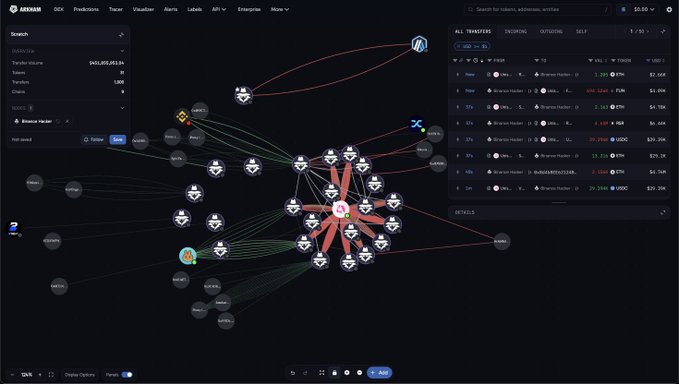
Binance’s list now runs to 26,000.
The Binance court order goes after the next step instead. Stolen coins only become spendable money when they pass through someone: an exchange, an OTC desk, a bridge, a stablecoin issuer. Once a business has notice of the order and of the wallet on the list, letting those funds through puts it on the wrong side of a court. Serving the order onchain means every one of those 26,000 addresses can carry that notice, and the list follows the money as it hops.
In other words, the hackers keep their keys. What gets harder is cashing out.
TRAIL MAP: Binance Hack: $6.3B Drained, Withdrawals Paused
BNB Price After the Court Order
The order barely moved the market. BNB trades at $590.24 at the time of writing, down 0.27% in 24 hours and 12.17% over the week, with $556.46 as the nearest swing low below. Bitcoin sits at $63,811, and the Fear & Greed index reads 10, extreme fear.
October 29 was three weeks ago. Binance now has a $6.5 billion order, a list of 26,000 wallets and, by its own last count, about $3.49 billion of the stolen assets still not frozen.

Satoshi Flipper has more than 20 years of trading experience, starting in stocks before moving into crypto in 2017, and holds an MBA from the Kellogg School of Management. The edge is reading the economic data: rate decisions, inflation, jobs numbers, earnings and the US markets that move Bitcoin.
More from Satoshi Flipper