The short version
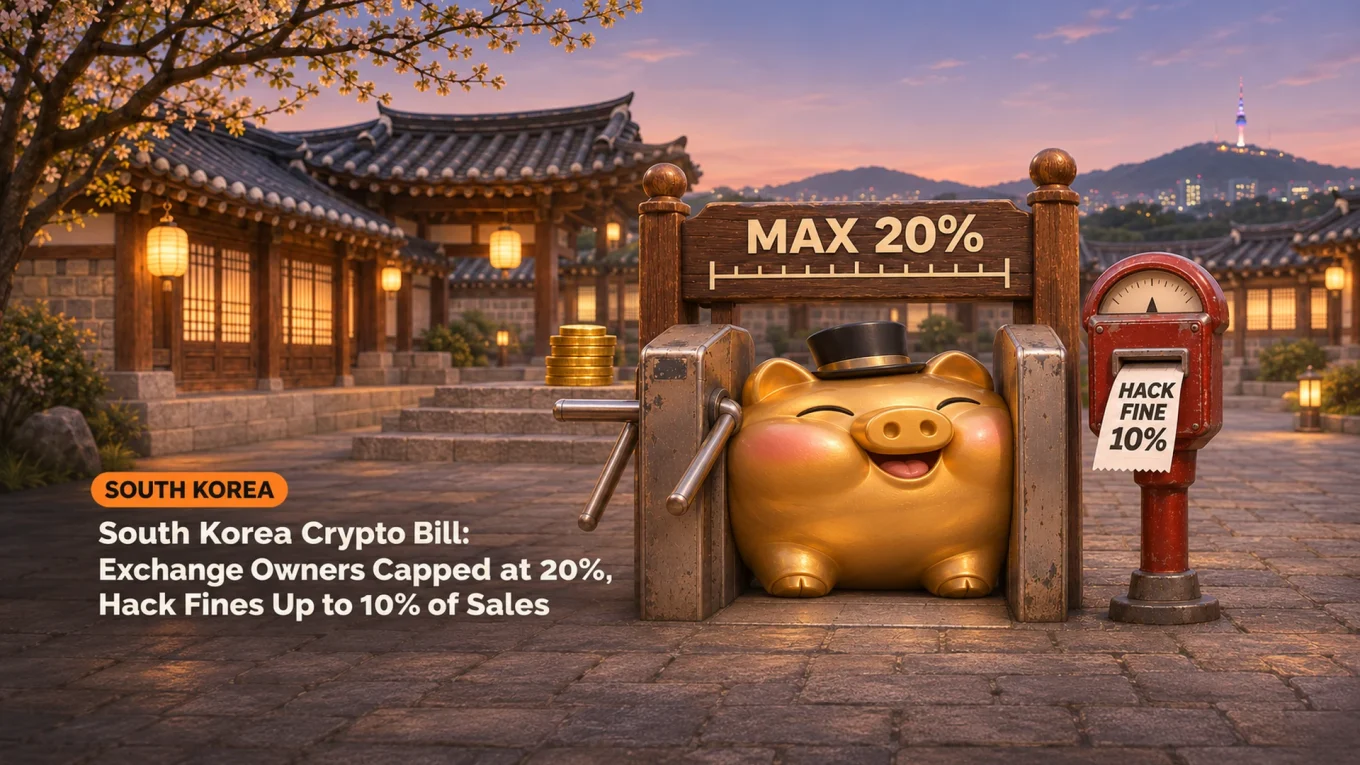
- South Korea crypto bill: the FSC’s November 24 proposal caps any major exchange shareholder at 20%, or 34% with approval, and all five big won exchanges have a holder reported above 20%.
- Exchanges would be liable for hacks regardless of fault, and fined up to 10% of sales if an accident follows a breach of their safety duties.
- Won stablecoins would start with groups in which banks own more than half, and foreign issuers would need a Korean office and an FSC registration.
- Next: the National Assembly has to pass it, the law starts a year after promulgation, and exchanges then get three years to meet the cap.
Seoul has decided its crypto exchanges are too important to belong to one person. The South Korea crypto bill the Financial Services Commission (FSC) set out on Tuesday would cap any major shareholder of an exchange at 20%, and the owners behind every big Korean platform are over that line today.
The same proposal makes exchanges pay for hacks even when they did nothing wrong, opens the door to won stablecoins and lets companies sell new tokens at home again. Nothing is law yet. So who has to sell, and what changes for people who trade there?
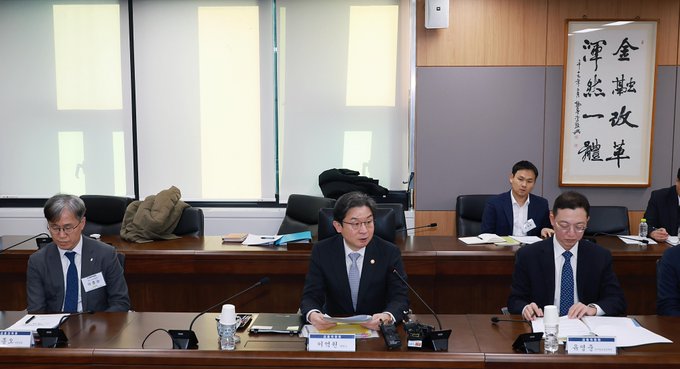
The FSC posted the meeting where the plan was presented:

[Photo News] FSC Chairman Lee Eog-weon presided over the virtual asset committee meeting where officials discussed a plan to introduce a new legislative bill on digital assets on November 24. fsc.go.kr/eng/pr020101/8…
Who Is Over the 20% Line?
All five of the big won exchanges, going by the stakes reported in Korea. Digital X is the former Korbit.
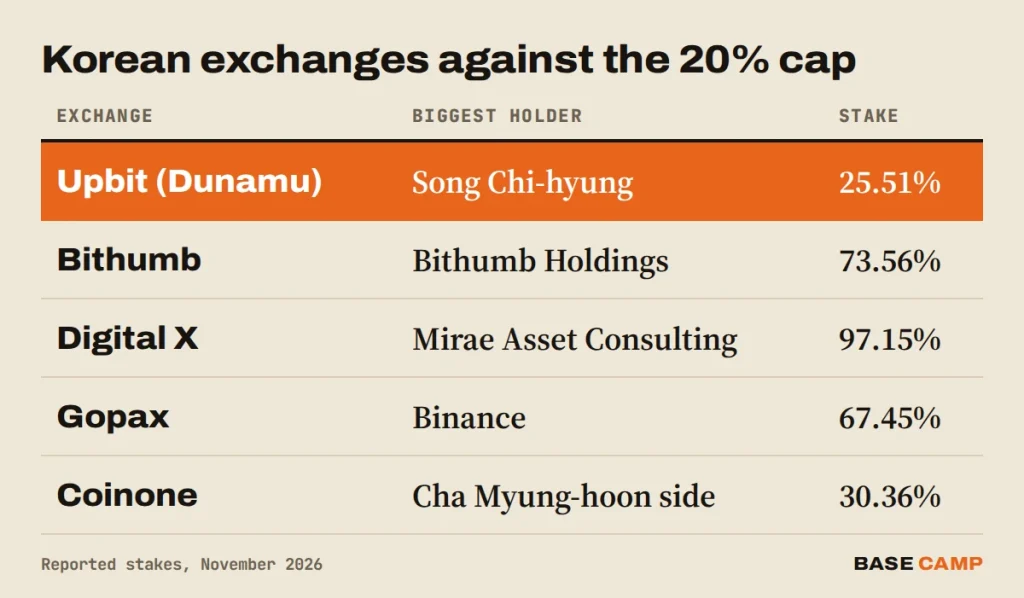
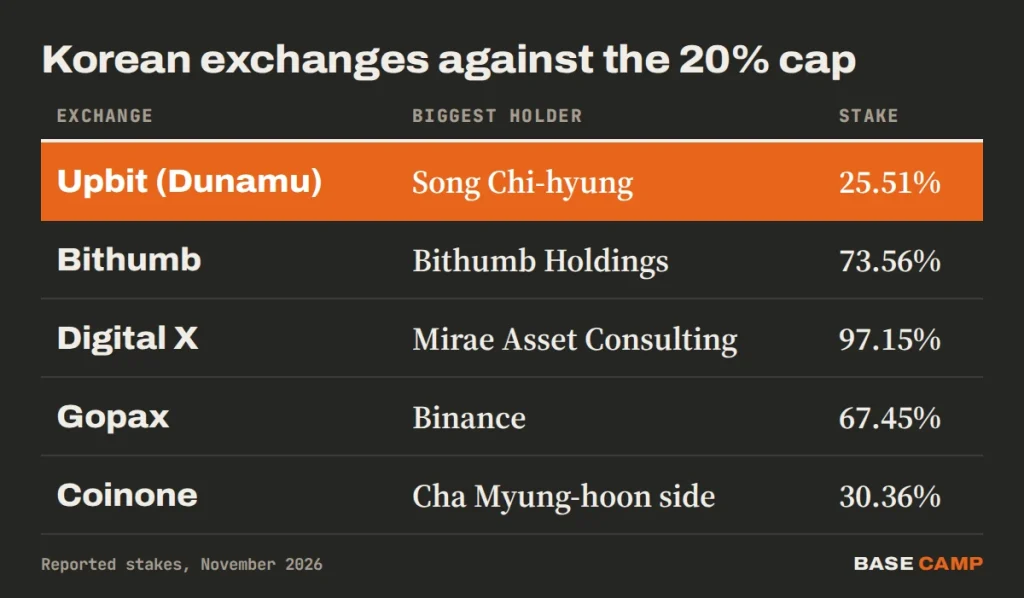
The FSC’s summary borrows the number from Korea’s rules for alternative stock trading systems. A holder can go up to 34% with the regulator’s approval. Voting rights above the cap are switched off.
Nobody is ordered to sell. But an FSC official said holding the excess remains a violation, and the regulator could answer it with a corrective order.
There is plenty of time, too. Exchanges get three years after they are designated as platforms, and small and mid-sized ones can get up to three more.
Sponsored · Affiliate link
Save 20% on fees trading on WEEX
Base Camp may earn a commission if you sign up. It never affects what we write.
What the Cap Does to the Upbit and Naver Deal
Upbit has the trickiest case. Its operator Dunamu plans to become a wholly owned unit of Naver Financial through a share swap. After it, Song would hold a reported 19.5% of Naver Financial, NAVER 17% and Dunamu’s vice chairman Kim Hyoung-nyon 10%.
Every one of those is under 20%. The catch is where you measure. The cap is expected to apply to an exchange’s direct shareholder, and that would be Naver Financial with 100%. Whether a holding structure gets an exemption is left to a later decree.
SIDE TRAIL: South Korean Crypto Exchanges Will Be Allowed to Freeze Withdrawals on a Suspected Hack
Who Pays When a Korean Exchange Is Hacked?
The exchange, whether or not it was at fault. The bill puts “strict liability” on digital asset firms after a hack or an IT failure.
The fine is a separate thing, with a higher bar. The FSC could impose a “punitive level” of surcharge, up to 10% of sales revenue, if the accident follows a breach of the firm’s safety duties. A hack alone doesn’t trigger it.
For users, the first part matters more. Arguing about blame would no longer decide whether an exchange owes them.
Won Stablecoins Start With the Banks
The other half of the South Korea crypto bill is about money that moves onchain. The FSC flagged it on X:

South Korea's financial regulator has unveiled draft rules that would allow local banks to issue stablecoins, a move that could pave the way for an easing of a nine-year-old ban on fundraising via initial coin offerings (ICOs). (Reuters) marketscreener.com/news/south-kor…
In the first stage, only groups in which banks own more than half could issue won stablecoins. A tech or fintech company can still be the largest single shareholder. The other terms:
- Capital: at least $3.7 million for an issuer.
- Reserves: at least 100% of what is issued, held with a manager such as a bank.
- Interest: none can be paid to holders.
Foreign issuers get in as well, though with more than a form to file. The FSC wants them supervised abroad, with a Korean office, enough money for local operations, a registration and a report on the token. Tokens that skip the process can’t be listed, traded or held in custody, so USDT and USDC would need that filing to stay on Korean order books.
Initial coin offerings come back too, nine years after Korea banned them. Issuers would need a white paper accepted by the FSC and a cooling-off period before they start selling.
TRAIL MAP: South Korea Set to Delay Its 22% Crypto Tax a Fourth Time, to 2029
When Would the South Korea Crypto Bill Take Effect?
One year after it is promulgated, and the National Assembly has to pass it first. Lawmakers can still raise the cap or strip it out.
Then do the sums. A bill promulgated in early 2027 would take effect in early 2028, and the three-year clock on ownership only starts once an exchange is designated. On that schedule, the first real deadline falls in 2031 or later.
The FSC says it wants “prompt passage.” For the owners of Korea’s biggest exchanges, prompt still means years.

VikingXBT has been trading crypto since 2017. The focus is futures, onchain data and automation. Onchain flows get checked before a chart is trusted, and anything repetitive gets automated. VikingXBT built Base Camp's own onchain scanner, which flags bundlers, snipers, dev holdings and wallet clusters in one view, and backtests strategies before trading them.
More from VikingXBT