The short version
- Binance hack recovery: the US filed on November 23 to forfeit more than $1.1 billion in stolen USDC, spread over 36 address entries on 18 blockchains.
- The frozen coins can’t be moved, so Circle has agreed to issue the same amount of new USDC to the US government after a forfeiture order.
- This USDC was already frozen, and the lawsuit doesn’t send it back to Binance by itself: the Justice Department counts more than $2.9 billion frozen, seized or returned out of over $6 billion stolen.
“The United States cannot access the Defendant Property.” That line sits in a 26-page complaint federal prosecutors filed in Washington on Monday, and it explains the odd shape of the biggest Binance hack recovery step so far.
The US wants a judge to hand it more than $1.1 billion in stolen USDC. Nobody can move those coins. So Circle, which issues USDC, has agreed to make new ones. The run-down:
- The target: all the USDC tied to 36 address entries on 18 blockchains.
- The status: blocked by Circle on or about October 29 and under a court restraining order since November 12.
- The swap: new USDC goes to the US government, but only after a forfeiture order.
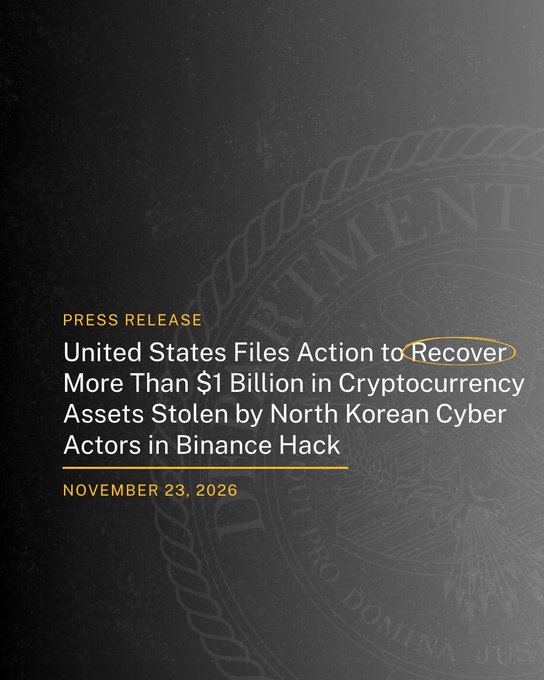
The Justice Department’s National Security Division announced the case on X:

Today, the Justice Department announced actions taken to forfeit over $1.1 billion in cryptocurrency that was criminally obtained by North Korean actors from Binance last month. This is part of the greater government effort to assist Binance in recovering over $6 billion in
Why Would Circle Mint Replacement USDC?
Because USDC frozen in place can’t be moved. Circle can block an address from sending or receiving USDC, but whoever holds the private key still controls the address, and prosecutors say that is North Korea’s Lazarus Group, also known as APT38.
Circle told the government it can’t pull the tokens out. Instead, the complaint says, it “has agreed to voluntarily issue new USDC in an amount equivalent” and transfer it to the United States once the court orders forfeiture. The filing calls it “Substitute USDC.” It doesn’t spell out what happens to the old tokens.
In other words, the old coins stay stuck and the value moves around them. That only works when a token has an issuer. Stolen Bitcoin has nobody to ask.
Sponsored · Affiliate link
Save 20% on fees trading on WEEX
Base Camp may earn a commission if you sign up. It never affects what we write.
Most of the Addresses Sit on Binance’s Own Platform
Read the address list and the picture shifts. Of the 36 entries, only four were destinations the hackers sent loot to or swapped it through. The other 32 are hot wallet and smart contract addresses on Binance’s own platform.
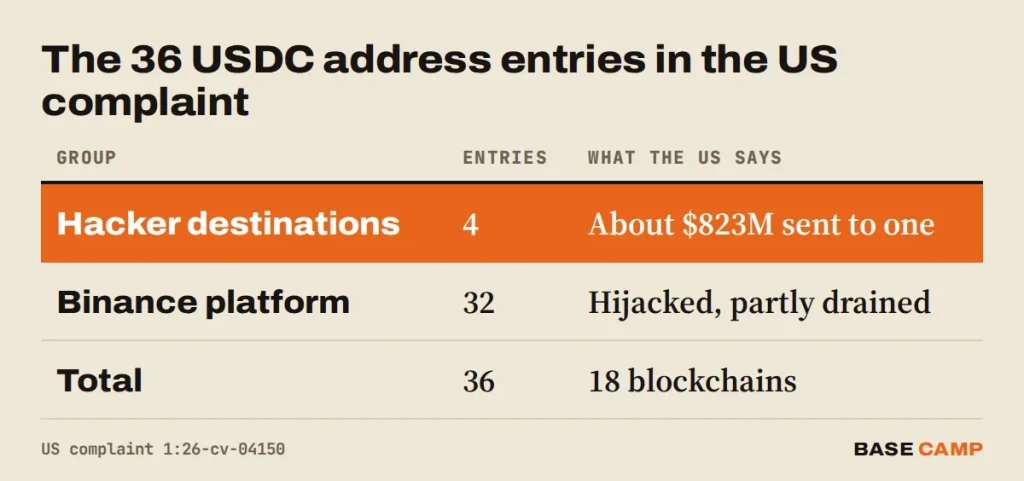
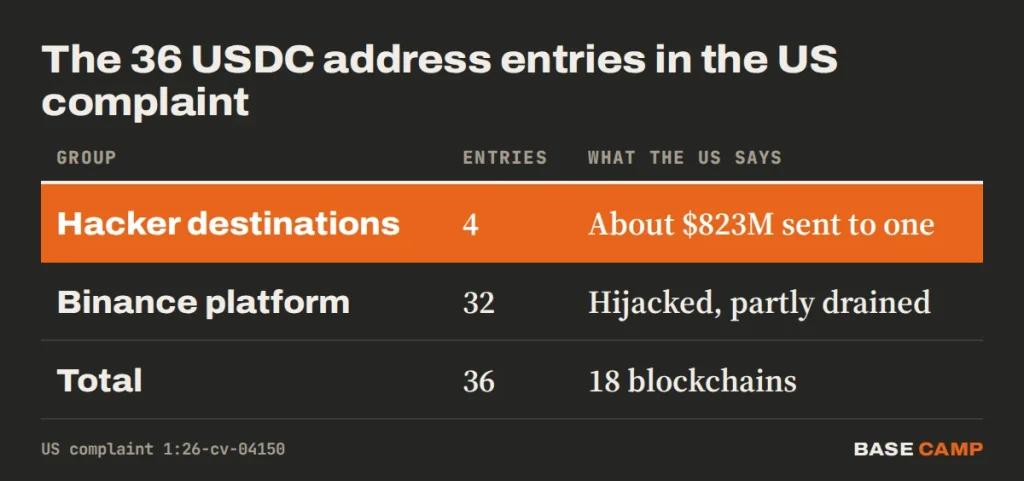
Attackers hijacked the Binance addresses through EIP-7702, an Ethereum feature that lets a normal wallet act like a smart contract. A “sweeper” then pulled out funds as they arrived. Circle’s freeze landed before everything was gone, and “it appears Binance no longer controlled them.”
The largest haul went elsewhere. At 20:41 UTC on October 29, about $780 million in USDC left Binance for a single Ethereum address, and another $43 million followed 18 minutes later. We checked that address on a block explorer: it still holds exactly 823,000,000 USDC.
The trail also runs backward. Some wallets that received Binance money also received funds stolen in September’s $387 million Bitget hack, according to the complaint.
SIDE TRAIL: Can Crypto Be Frozen? Who Froze $2.7B of the Binance Hack, and Why $2.4B Got Away
Does the Binance Hack Recovery Case Pay Binance Back?
Not yet, and not automatically. The complaint asks for the property to go to the United States, and for anyone with a claim to come forward. It doesn’t promise Binance a payment or set a date for one.
The Justice Department’s announcement points that way, though. It calls the case part of an effort “to assist Binance in recovering over $6 billion in stolen assets,” and says more than $2.9 billion has been frozen, seized or returned so far.
Don’t add the new $1.1 billion to that. These coins were already frozen, so the lawsuit changes their legal path and leaves the size of the pile alone. The allegations still have to hold up in court, too. North Korea has denied the hack.
Binance has its own case running in Abu Dhabi, where it won a $6.5 billion freezing order last week. The coins no issuer controls are a different fight, with 335,062 ETH split across fresh wallets days ago.
TRAIL MAP: Binance Hacker Moves 335,062 ETH in Two Days as Ethereum Falls Below $1,600
Freezing the USDC took Circle a blocklist. Getting the dollars back takes a judge, a forfeiture order and coins that don’t exist yet.

TANG has been trading crypto since 2017. The focus is technicals, DeFi and onchain data. On the chart, that means high-timeframe support, moving averages and momentum divergences. Onchain, it means regular checkups on where the data puts the cycle. TANG once ran CryptoJungle, a free community for researching and trading together, and brings that same spirit to Base Camp as one of its co-founders.
More from TANG