The short version
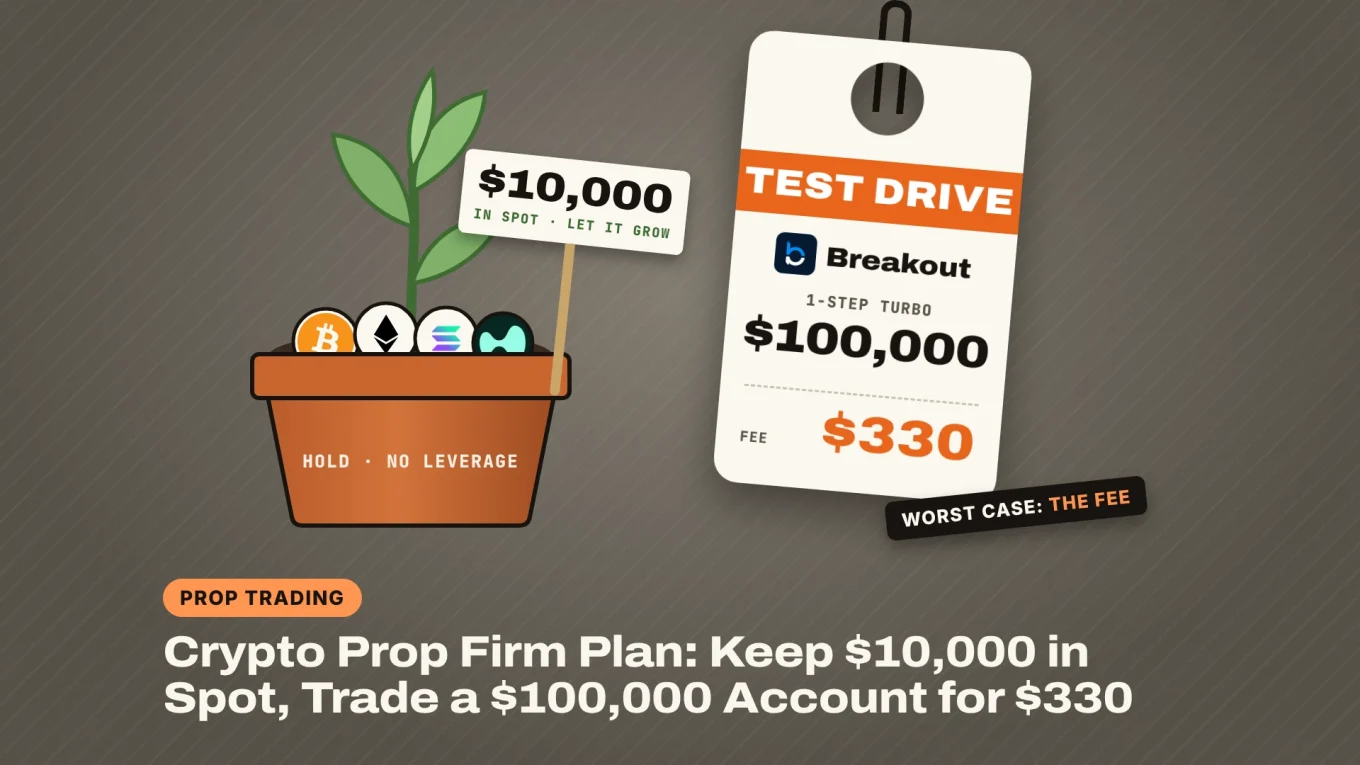
- Crypto prop firm plan: a $10,000 holder keeps the coins in spot and trades a $100,000 Breakout Turbo account instead, for a one-off $330 fee.
- The same $100,000 of exposure on your own account needs 10x leverage, where a 10% move can wipe out all $10,000; on the evaluation the worst case is the $330.
- The catch: Turbo ends at a 3% loss ($3,000) and most traders fail the first try, so set an attempt budget, like three tries, before the first trade.
A crypto prop firm lets a $10,000 portfolio do two jobs at once. The coins stay in spot, Bitcoin, Ethereum, Solana or HYPE, with no leverage on them. The urge to trade goes to a $100,000 Breakout account that costs $330 to try.
That fee is the most the trading side can lose. The usual route puts the whole $10,000 up as margin on an exchange and hopes no wick reaches the liquidation price. So how does the split work, and what does $330 really buy?
The trading side isn’t limited to crypto either. On October 29, Breakout added gold to a list that includes Brent oil, natural gas, the S&P 500 and the Nasdaq 100, and cut its fee on those trades in half:

“wen gold”
Now. Gold is live on Breakout. Up to 5x, $500K notional.
“lower the fees”
Done. Fees on every RWA trade you take just got cut in half. Nasdaq 100, S&P 500, gold, all of them.
How a Crypto Prop Firm Splits Your Risk
You pay a one-off fee for an evaluation, trade a demo account to a profit target without breaking two loss limits, and get a funded account that pays out 80% of its profits. The fee is non-refundable, and a breach ends the evaluation on the spot, with no reset.
Breakout Turbo is the firm’s cheapest and tightest plan. It asks for a 9% gain and allows a 3% loss, both fixed to the starting balance, plus a 3% daily loss limit:
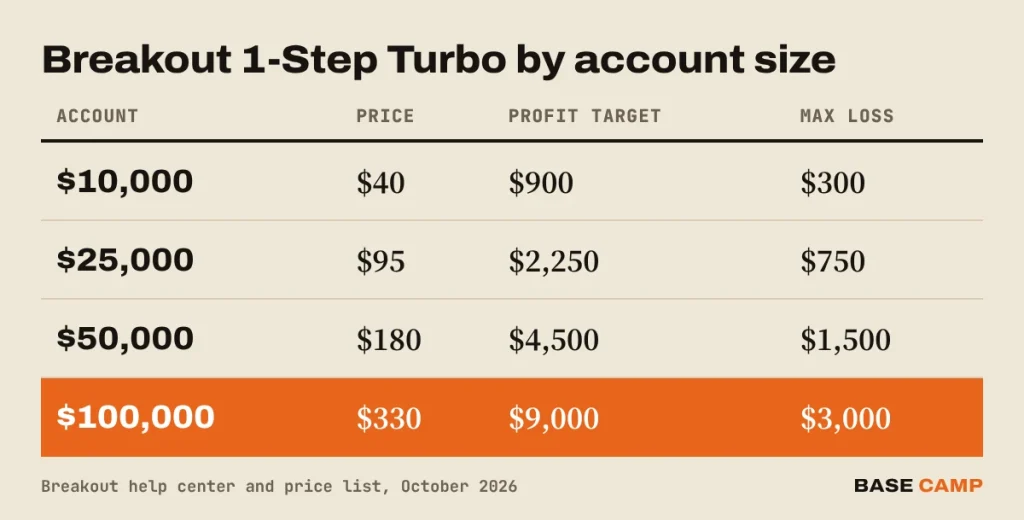
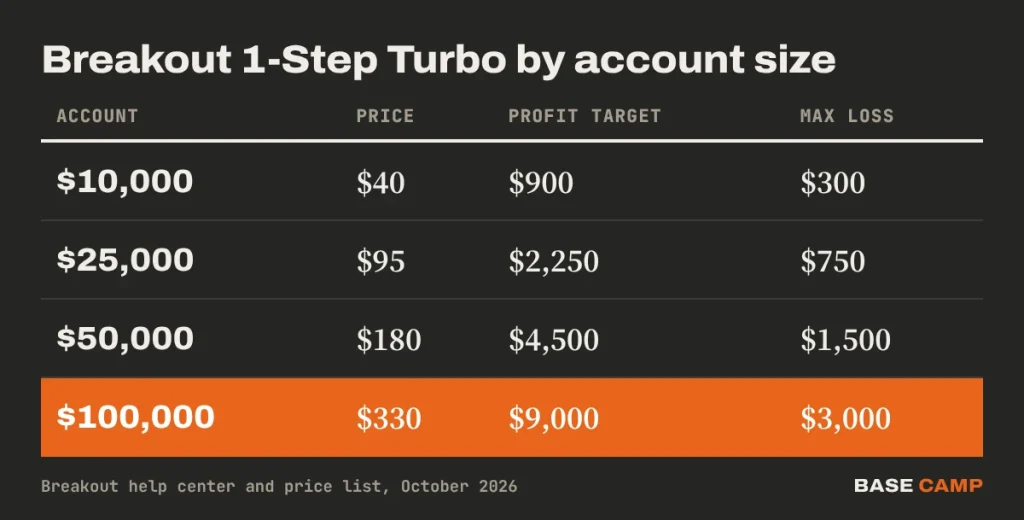
For a portfolio holder, the bottom row is the point. For $330, the trading side gets a $100,000 account, and nothing in the spot bag is on the line.
Sponsored · Affiliate link
Save 5% when buying Breakout Prop evaluations
Base Camp may earn a commission if you sign up. It never affects what we write.
The $10,000 Stays in Spot, Where It Can’t Be Liquidated
Spot coins can fall, but they can’t be liquidated. A holder of Bitcoin, Ethereum, Solana and HYPE can sit through a 30% drop and wait for the next cycle. A trader using the same coins as margin may not get to wait.
That is the whole idea of the split. The long-term bag rides the market on its own clock, and the daily itch to trade goes somewhere it can’t touch it. Plenty of holders end up selling their spot to chase a quick move, or posting it as collateral for one. A crypto prop firm gives that energy a fenced field.
SIDE TRAIL: Crypto Prop Trading for Small Accounts: How One Fee Caps Your Risk
Same $100,000 Exposure, Two Very Different Worst Cases
To trade $100,000 of Bitcoin on your own, a $10,000 account needs 10x leverage. A move of roughly 10% against the position liquidates it, and the portfolio goes with it. Bitcoin has dropped more than 10% inside a month five separate times in 2026; in early February it fell from $79,424 to $62,345 in four days.
The prop route turns that around:
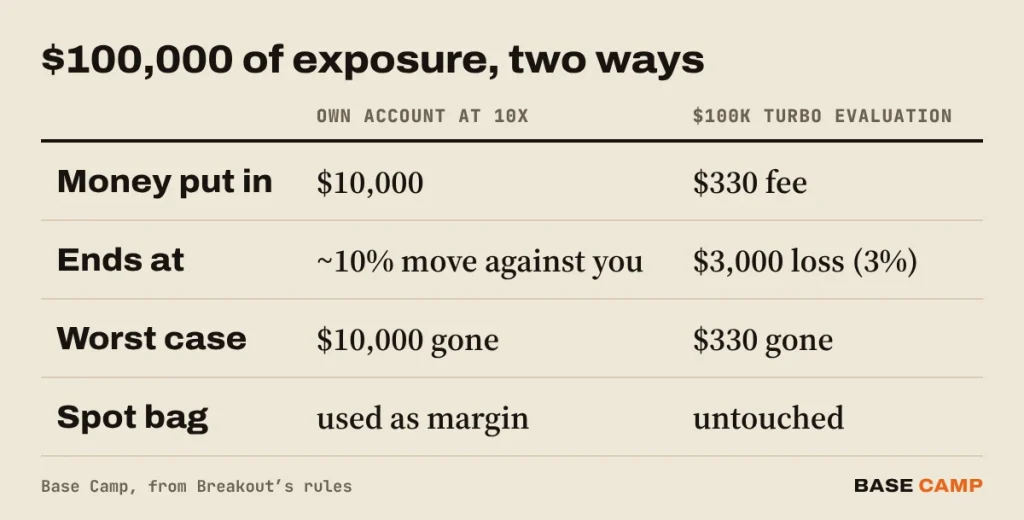
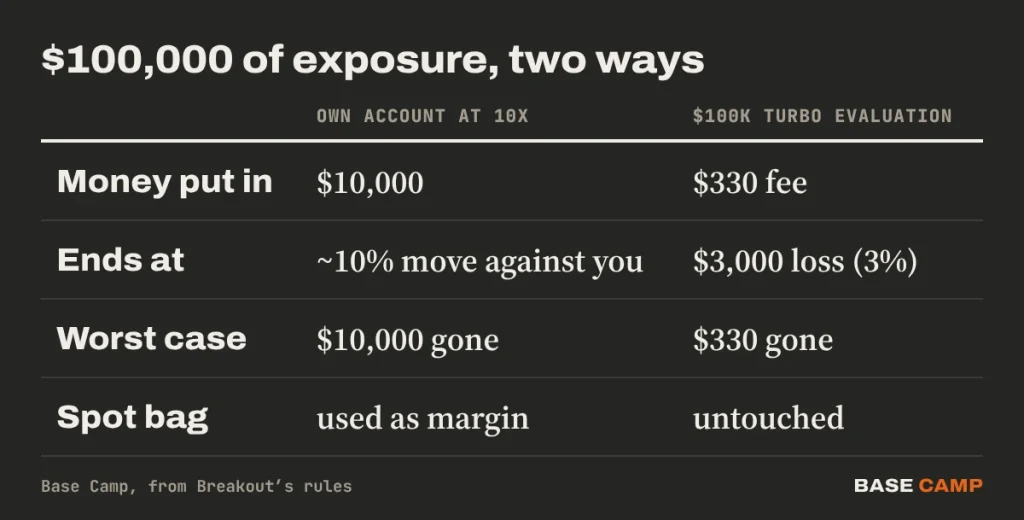
The catch is in the second row. Prop firm crypto leverage at Breakout is 10x on Bitcoin, 5x on Ethereum and Solana and 3x on HYPE, but a full $100,000 Bitcoin position would hit the 3% floor on a 3% move. The account gives you size to work with, not room to swing all of it at once.
Trading the $100,000 Account Without Breaching It
Your risk per trade comes from the $3,000 floor. The $100,000 on the label only sets how big a position can get. At 0.5% a trade, $500, six straight losers end the attempt. At 0.25%, $250, it takes twelve.
The position-sizing rules are the same as on any account. Set the stop first, then size the trade so the stop costs your fixed amount. With $500 at risk and a 2:1 target, each winner adds $1,000, so 15 winners against 12 losers reach the $9,000 target. The daily limit also counts open trades, so a position running deep red can end the day for you.
Costs still count. Each crypto trade pays a simulated 0.04% each way, and gold, oil and index trades now pay 0.02%. Positions held past midnight UTC pay 0.033% a day, all taken from the demo balance. Gold and Brent get 5x leverage, natural gas 3x.
What One Payout Buys Back
Pass, and the account turns funded. A 2% month on $100,000 is $2,000, and the 80% split pays $1,600. That covers almost five more $100,000 Turbo attempts, and Breakout lets you pay for a new evaluation straight from your payout balance.
Or the $1,600 goes into the spot bag. That is the best version of the plan: the trading side feeds the spot portfolio, and the portfolio never has to rescue the trading side. There are no payouts during the evaluation. Once funded, after a KYC check and a funded-trader agreement, you can withdraw as often as you like, any time you have no open trades, as long as each payout is at least $50. Taking money out often is the smart habit: profit that has left the account can’t be lost back.
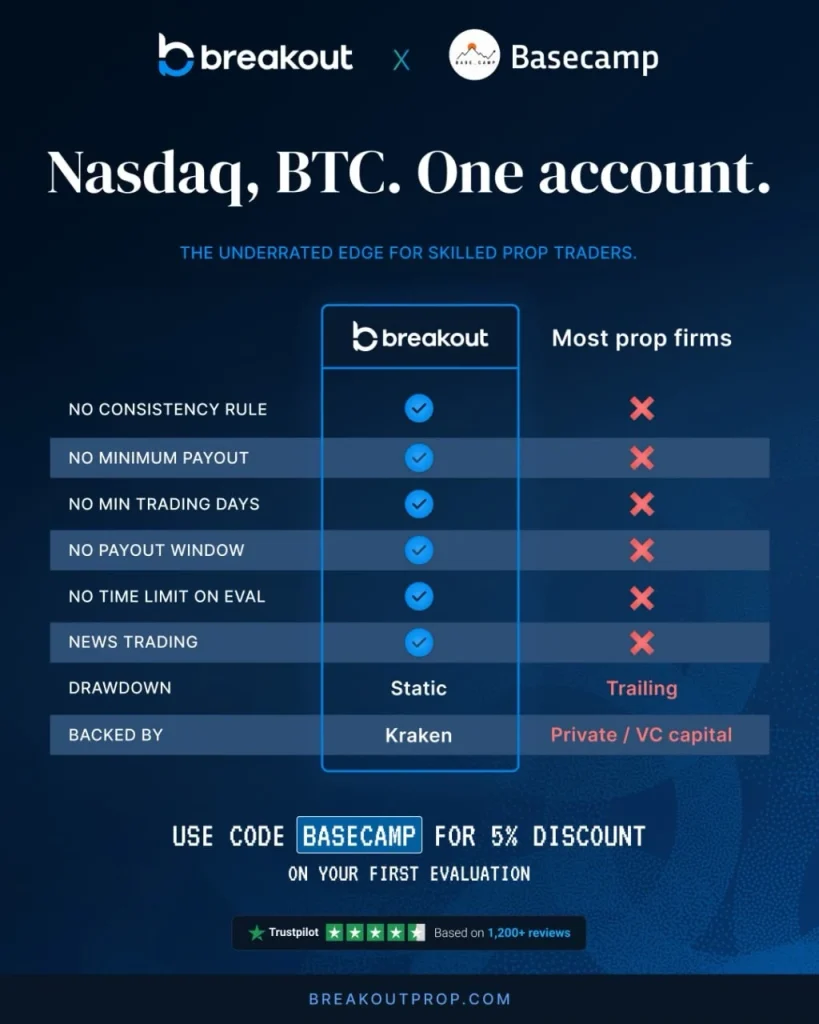
How Breakout’s rules compare with most prop firms:
The Catch: Set an Attempt Budget First
Breakout doesn’t publish a pass rate, and most traders fail the first try. Three failed $100,000 Turbo attempts cost $990, close to 10% of a $10,000 portfolio, which is the money the plan was meant to protect.
So size the attempts like a trade. The $50,000 Turbo costs $180 for half the size with the same rules in proportion, so three tries are $540. Classic gives 6% of room instead of 3%, at $800 for $100,000. Pick the number of attempts before the first one and stop when it’s spent.
One more rule matters: Breakout bans trading on signals, communities or other people’s posts. The trades have to be your own.
TRAIL MAP: Futures and Leverage Explained: Perps, Margin and How Liquidation Really Works
Who This Crypto Prop Firm Plan Fits
It fits the holder who believes in a long-term bag and keeps getting pulled into trading it. The coins stay in spot, and the trading happens in an account where the worst case has a price tag.
It doesn’t fit someone who wants the evaluation to win back spot losses, or who will keep buying attempt after attempt. The spot bag only stays safe while the evaluation budget stays small.
Thinking about a Breakout evaluation? Join the camp on Telegram and ask away. The crew is happy to help with any questions about the plans and the rules.

On the climb since 2017. Trades futures and reads onchain data. Automates the boring parts.
More from VikingXBT →