
The short version
- CFTC crypto guidance from Monday, November 23, lets US derivatives exchanges and clearing houses count Bitcoin, Ethereum and payment stablecoins toward 12 months of operating costs.
- Staff would accept haircuts of at least 20% on Bitcoin and Ethereum and 2% on payment stablecoins.
- None of it counts toward the separate cash part (three to six months of costs), and customer margin rules don’t change.
Two CFTC divisions told US derivatives exchanges and clearing houses on Monday, November 23, that Bitcoin, Ethereum and payment stablecoins can count toward a reserve they must all keep: enough to cover a year of operating costs. The CFTC crypto guidance is a 10-page staff letter, and the useful part is how much of the year it leaves out.
What it settles, in short:
- What counts: the three asset types above, at market value minus a haircut (a discount for risk).
- What doesn’t: any of them, for the months that must sit in cash or highly liquid securities.
- What it isn’t: a change to the margin you post to trade.
CFTC Chairman Michael Selig welcomed it on X:

Pleased to see @CFTC staff continue to provide important clarity around crypto assets in US derivatives markets through today’s staff advisory. More below:
How Much Crypto Can an Exchange Actually Count?
For futures exchanges and clearing houses, no more than half of the required year. A futures exchange (a designated contract market, or DCM) and a clearing house must hold at least six months of costs in cash or highly liquid securities. A swap venue (a swap execution facility, or SEF) needs three months, or its wind-down costs if those are higher.
Crypto can’t fill that part, stablecoins included. Staff say the coins aren’t “cash” under US accounting rules, and they aren’t securities either.
The rest gets a discount. Staff would not object to at least 20% off Bitcoin and Ethereum, and 2% off payment stablecoins, the same cuts already accepted for futures brokers’ own holdings. A coin that’s hard to sell and isn’t a payment stablecoin generally gets a 100% haircut, so it counts as zero.
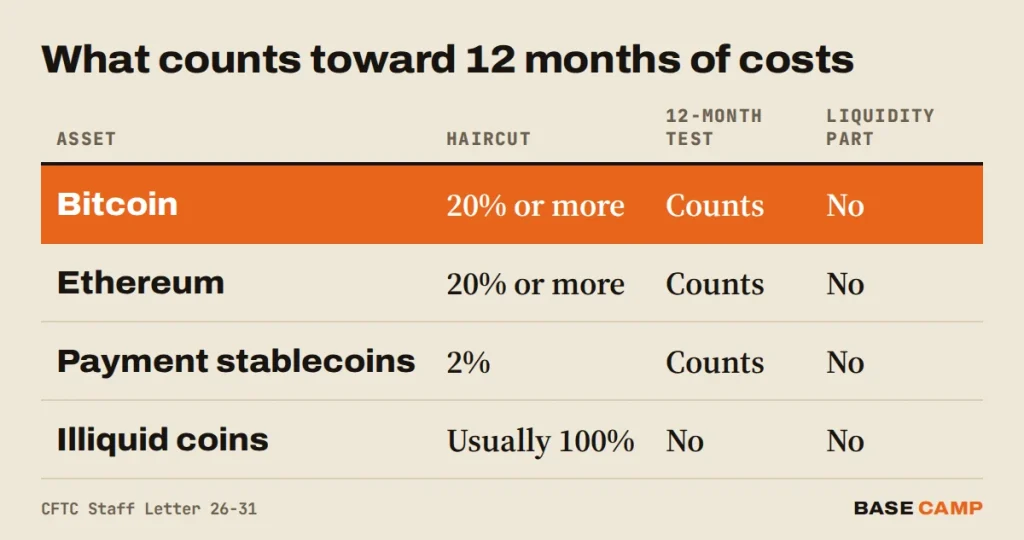
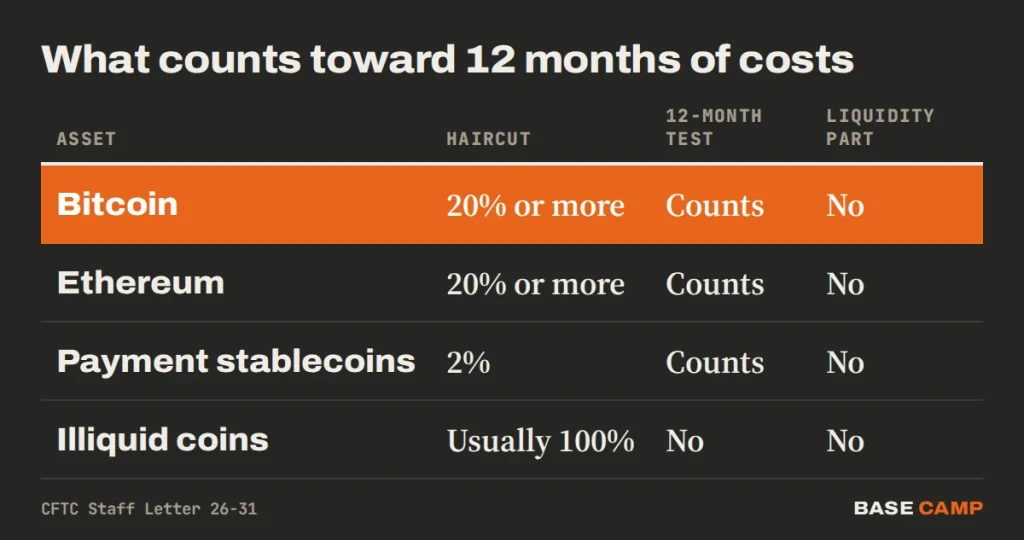
Take a made-up futures exchange with $10 million in yearly costs. Roughly $5 million has to be cash or liquid securities. The other $5 million could be about $6.25 million in Bitcoin, or $5.1 million in stablecoins.
Sponsored · Affiliate link
Save 20% on fees trading on WEEX
Base Camp may earn a commission if you sign up. It never affects what we write.
Why Does This Matter for New US Exchanges?
Because the reserve is one of the costs of getting in. The letter says applicants for a license, as well as existing venues, already hold crypto and had asked if it counts.
Katherine Kirkpatrick Bos, a lawyer, called the cost of holding that much money an impediment to these licenses:

This is significant. Tl;dr – DCMs, SEFs, & DCOs (exchanges & clearinghouses) can count bitcoin, ether, & stables toward their financial resources (w/ haircuts). People don't realize that one of the impediments to these licenses is the cost of holding a lot of $ – this will help.
There’s a catch, and the letter names it: wrong-way risk, when an exchange loses money at the same time as the coins in its reserve fall. A crypto venue in a crypto bear market is the textbook example.
Bitcoin trades around $60,400 at the time of writing, down about 25% in 30 days. That drop is bigger than the 20% minimum haircut. Reserves are valued at the current price, so a falling coin shrinks the buffer, and clearing houses must redo that math at least monthly. The barber keeps cutting, whether you like the style or not.
SIDE TRAIL: Backpack CFTC Approval: BP Price Jumps 34% as Exchange Wins US License for Perps With One Global Order Book
What the CFTC Crypto Guidance Doesn’t Change
Your collateral rules, first of all. This is the exchange’s own money for its own bills. Using Bitcoin as customer margin falls under separate CFTC staff letters. The new one also says nothing on whether crypto can back a clearing house’s default resources, the money that covers a failed member.
Nor is it a rule. The CFTC’s release says the advisory is the view of staff only, creates no enforceable rights, isn’t a no-action position (a promise not to recommend enforcement) and may not reflect the Commission’s view. Anyone who wants to count another coin is told to talk to staff first.
A vote by the Commission would make it firmer. A later staff letter could just as easily revise it. Actual rules are moving on another track, the CFTC’s plan for leveraged retail trading, which is open for comment until December 14.
TRAIL MAP: CFTC Crypto Rules Explained: The Plan to Bring Leveraged Retail Crypto Trading Onshore
The same day, the CFTC did adopt an actual rule, on how certain event contracts report data. Selig said the agency “will no longer regulate market participants through a patchwork of no-action letters.” The crypto reserve advice arrived, for now, as a letter.

TANG has been trading crypto since 2017. The focus is technicals, DeFi and onchain data. On the chart, that means high-timeframe support, moving averages and momentum divergences. Onchain, it means regular checkups on where the data puts the cycle. TANG once ran CryptoJungle, a free community for researching and trading together, and brings that same spirit to Base Camp as one of its co-founders.
More from TANG