The short version
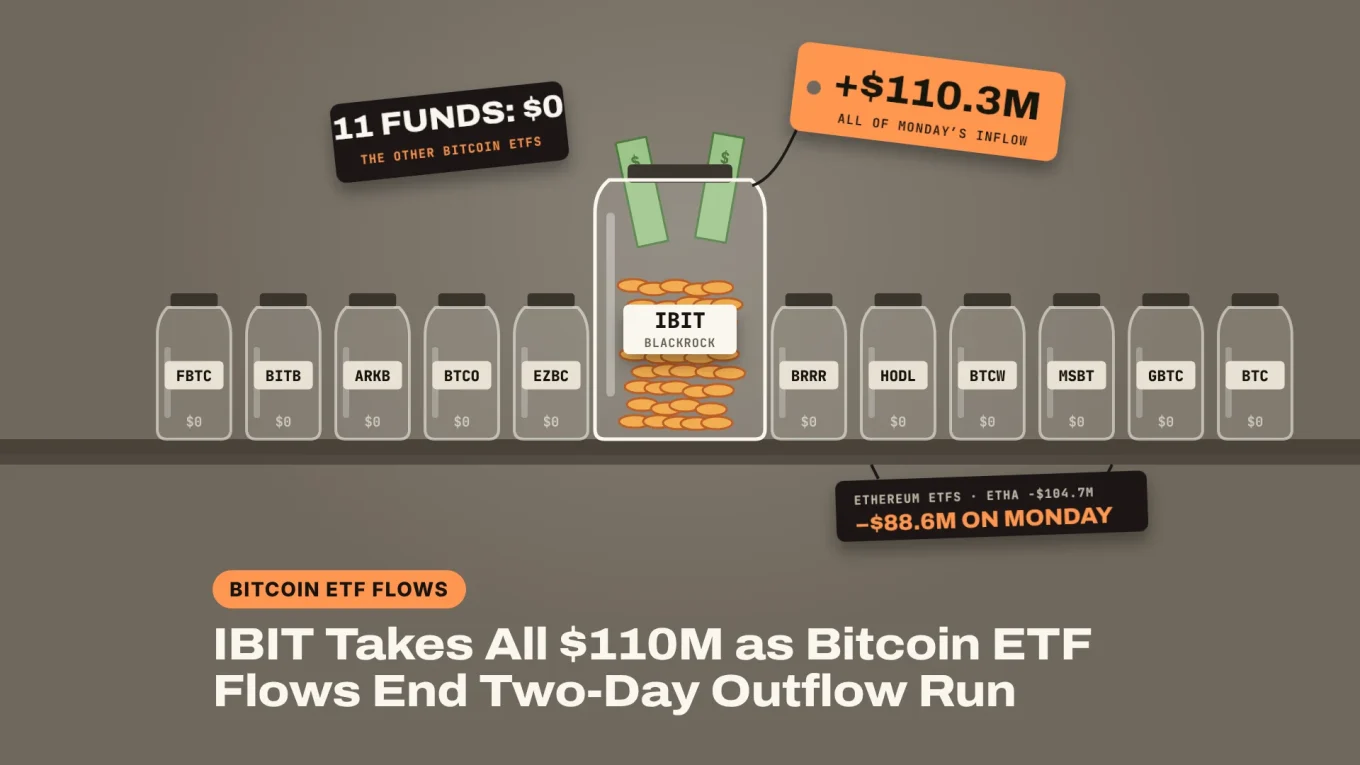
- Bitcoin ETF flows turned positive on October 26 with a net $110.3 million, and every dollar went into BlackRock’s IBIT while the other eleven funds reported zero.
- It ends a two-day run that cost $773.5 million, but IBIT won back less than a third of its own $364.4 million exit, and Ethereum ETFs lost another $88.6 million.
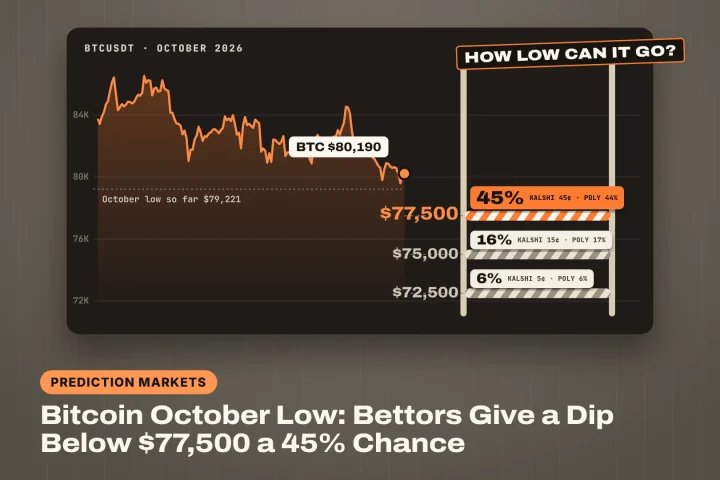
- The crew is watching whether other funds join IBIT, BTC at $79,816 against the $79,221 weekend low, and the Fed decision on Wednesday at 18:00 UTC (2:00 p.m. in Washington).
Bitcoin ETF flows turned positive on Monday, but only one fund showed up. US spot Bitcoin ETFs took in a net $110.3 million on October 26, and every dollar of it went into BlackRock’s IBIT. The other eleven funds reported nothing.
That ends a two-day run that cost the group $773.5 million on Thursday and Friday. Ethereum ETFs went the other way and lost $88.6 million, after four straight losing weeks. BTC trades at $79,816 at the time of writing, back under $80,000, with the Fed decision two days away. So is one fund enough to call the selling over?
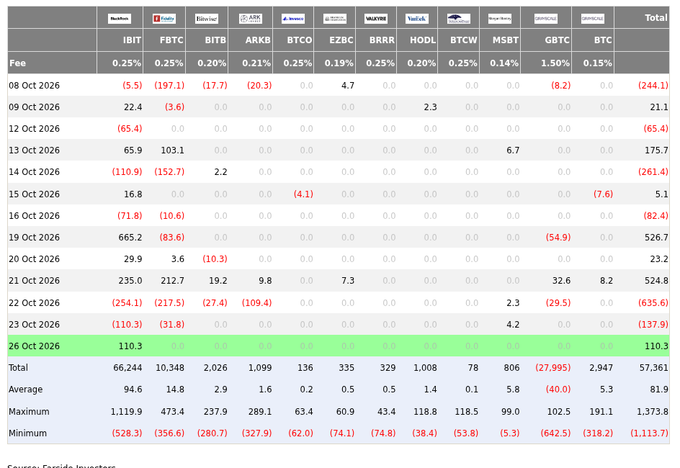
Farside’s Monday update shows the split, fund by fund:

𝗕𝗶𝘁𝗰𝗼𝗶𝗻 𝗘𝗧𝗙 𝗙𝗹𝗼𝘄 (𝗨𝗦$ 𝗺𝗶𝗹𝗹𝗶𝗼𝗻) – 2026-10-26
TOTAL NET FLOW: 110.3
IBIT: 110.3
FBTC: 0
BITB: 0
ARKB: 0
BTCO: 0
EZBC: 0
BRRR: 0
HODL: 0
BTCW: 0
MSBT: 0
GBTC: 0
BTC: 0
How Did Bitcoin ETF Flows Turn Positive on Monday?
IBIT did it alone. BlackRock’s fund took in $110.3 million, Farside’s data shows, while FBTC, ARKB, BITB, GBTC and the rest all printed zero. No fund lost money, which is something after last week.
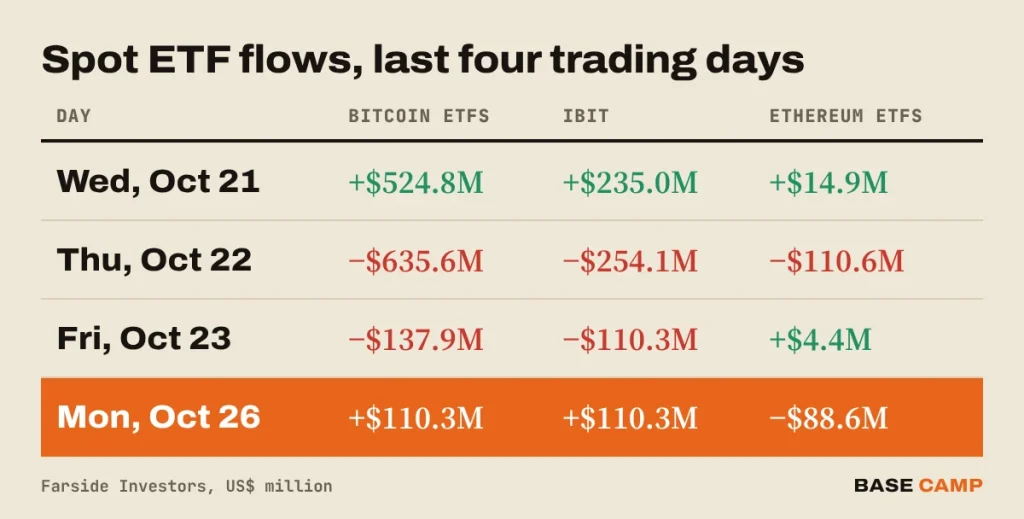
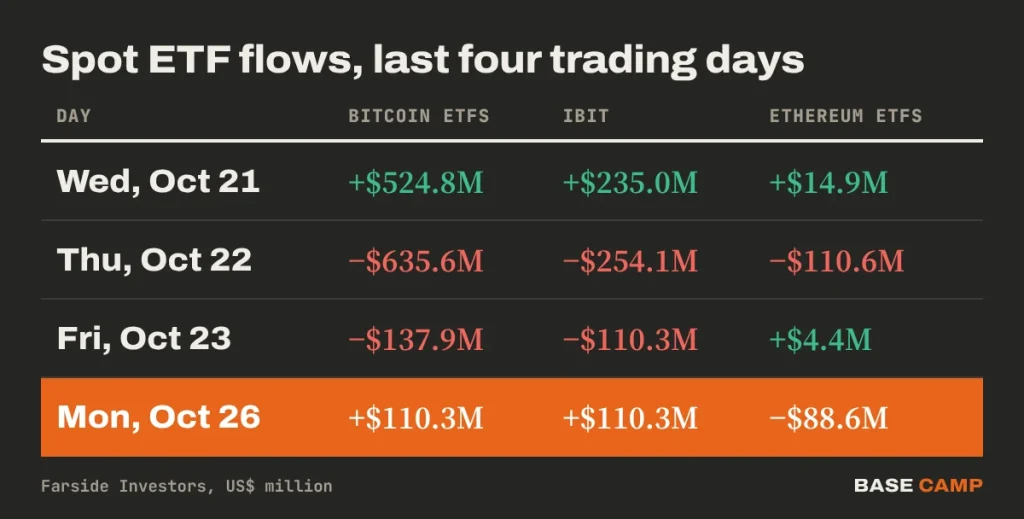
Put that next to Thursday and Friday, and Monday looks small. IBIT alone lost $364.4 million over those two days, so it won back less than a third. October is still $203.2 million in the red for the Bitcoin funds, down from $313.5 million on Friday.
Sponsored · Affiliate link
Save 20% on fees trading on WEEX
Base Camp may earn a commission if you sign up. It never affects what we write.
Why Does It Matter That Only IBIT Bought?
Because one buyer is a thin floor. Thursday’s exit hit five funds at once, from BlackRock and Fidelity to ARK, Bitwise and Grayscale, which is what broad selling looks like. Monday’s return came through one door.
That fits the pattern of Bitcoin ETF flows over the last few weeks, where the big daily numbers in both directions tend to start and end at the same fund in New York. IBIT took in $565.7 million last week while the other eleven funds lost $264.5 million between them. When the money comes back, it comes back to BlackRock first. The rest of the field is still waiting for its buyers.
One caveat on the zeros: some issuers report late, and Farside updates the row when they do. A zero can turn into a number by the time the US market opens.
Why Are Ethereum ETFs Still Losing Money?
The same fund keeps selling. BlackRock’s ETHA lost $104.7 million on Monday, more than the group’s total, while Fidelity’s FETH took in $16.1 million, per Farside.
That puts Ethereum ETF outflows at $1.26 billion for October, with ETHA behind $1.13 billion of it. The funds have now lost money four weeks in a row, and the new week opened the same way. ETH trades at $2,310, down 14.3% in 30 days, against a 5.6% drop for BTC.
SIDE TRAIL: Bitcoin ETFs End the Week Up $301M Despite Thursday’s $636M Exit
Bitcoin Price Analysis: Can BTC Get Back Above $80,000?
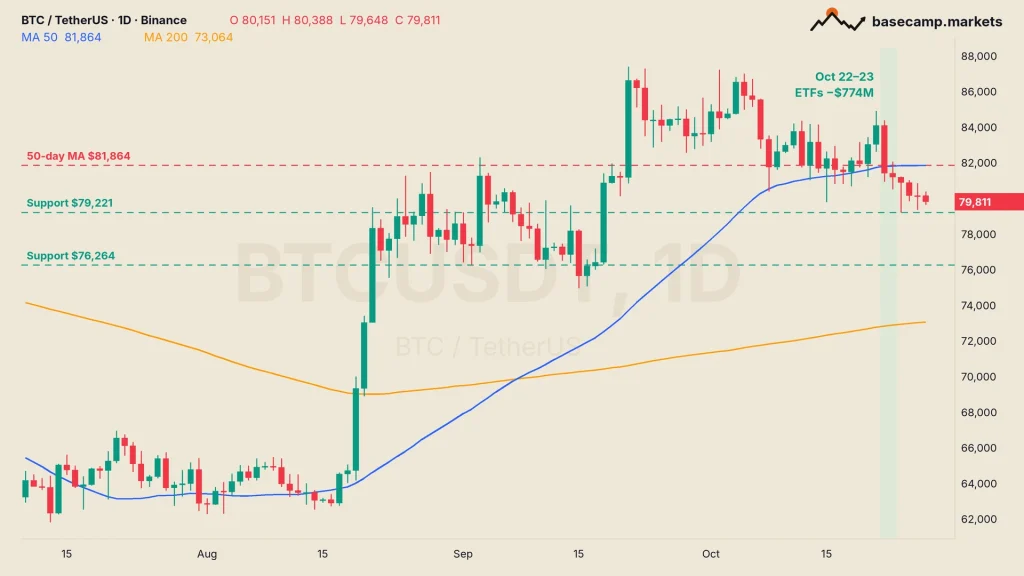
Not yet. The IBIT money barely moved the BTC price, which closed Monday at $80,151 and slipped to $79,816 today. It has now closed five days in a row under its 50-day moving average, which sits at $81,864.
- The ceiling: $81,864. The 50-day average, which BTC lost on Thursday’s sell-off.
- The floor to defend: $79,221. Saturday’s low, the bottom of the weekend range.
- The deeper support: $76,264. The next swing low, with the 200-day average lower at $73,064.
In the bull case, the other funds join IBIT, BTC reclaims $80,000 and retests the 50-day at $81,864. In the base case, flows stay thin and BTC chops between $79,221 and $81,864 into the Fed. In the bear case, a fresh outflow day breaks Saturday’s low and opens the way to $76,264.
TRAIL MAP: Indicators Worth Knowing: Moving Averages, RSI and Volume
The Fed decides on rates on Wednesday at 18:00 UTC (2:00 p.m. in Washington). Until then, watch whether Fidelity and the others report buyers too. One fund buying is a start. Five funds buying would be a turn.

In crypto since 2016. Covers altcoins and the daily market. When not trading, out climbing and traveling.
More from Teddy →