The short version
- EU crypto sanctions get their own team: the Commission launched the EU Crypto Sanctions Task Force on November 5, inside a new sanctions office.
- It brings Commission and national experts together to find and close crypto routes around EU financial sanctions; an EU diplomat says it runs 12 months with help from Ukraine and the UK.
- A7A5, the rouble stablecoin the EU sanctioned in 2025, still has about $478 million outstanding on Tron and Ethereum.
“We will not allow new technologies or third-country jurisdictions to become safe havens for sanctions evasion.” That is how Commissioner Maria Luís Albuquerque framed the launch of the EU Crypto Sanctions Task Force, the bloc’s first unit built only for crypto sanctions on Russia and the workarounds around them.
Here’s what Brussels just set up:
- A new sanctions office inside the Commission, with the crypto task force sitting in it.
- One room for Commission and national experts to spot crypto routes around EU financial sanctions and shut them.
- A 12-month first run, with experts from Ukraine and the UK, according to an EU diplomat.
The news went out quietly. An intelligence account flagged it overnight, two days after the meeting in Brussels:

INTEL: EU sets up crypto task force to stop Russia dodging sanctions with digital assets
What Is the EU Crypto Sanctions Task Force?
It is a working group of sanctions and crypto specialists. No new law comes with it. Albuquerque announced it after chairing the tenth meeting of the EU’s high-level group on sanctions on November 5, and the Commission’s statement calls it “an important step in strengthening our capacity to detect and tackle attempts to circumvent EU financial sanctions through crypto assets.”
The wider office covers the whole life of a sanction, from drafting to enforcement. Albuquerque said it “will strengthen coordination, provide faster guidance to Member States and improve data sharing and analysis.” Today each of the 27 countries enforces EU sanctions on its own. That is the gap a crypto desk in Kyrgyzstan slips through.
The 12-month run and the help from Kyiv and London come from an EU diplomat who spoke to the Kyiv Independent. Britain already sanctions plenty of Russian crypto networks, so its investigators arrive with practice.
Sponsored · Affiliate link
Save 20% on fees trading on WEEX
Base Camp may earn a commission if you sign up. It never affects what we write.
Where Is A7A5 Now?
Still very much alive on-chain. The A7A5 stablecoin, pegged to the rouble, has about 38.66 billion tokens on Tron and 588 million on Ethereum, read straight from its two contracts. At the Bank of Russia’s rate of 82.14 roubles per dollar, that is about $478 million outstanding.
The statement never names A7A5, but it is the obvious first target. The EU sanctioned its developer, its Kyrgyz issuer and a platform where large volumes of it traded in October 2025, and the US Treasury tied almost $200 million of A7A5 flows to MEXC when it cut that exchange off from US banks last week.
SIDE TRAIL: MEXC FinCEN Order Cuts Exchange Off US Banks Over $16 Billion
Supply alone says little about use, though. One Tron wallet holds about 88% of the supply, and the coin’s 24-hour trading on Ethereum was about $2,000 on Sunday. A7A5 works more like a settlement pipe between a few desks than a coin anyone trades, which is why a task force that follows wallets may hurt it more than another listing.
How Far Has the EU Gone on Crypto?
Each of the last three packages pushed further. The task force is the first step aimed at enforcement.
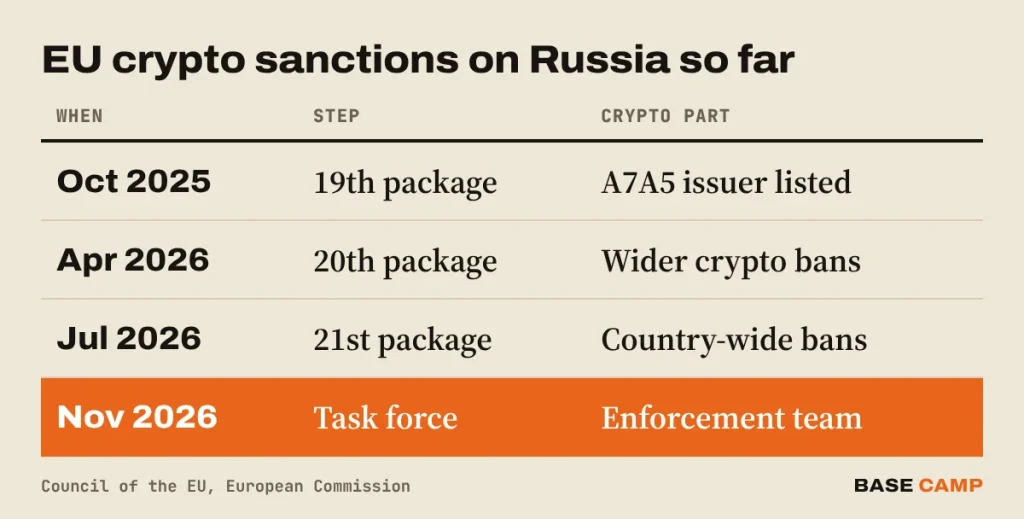
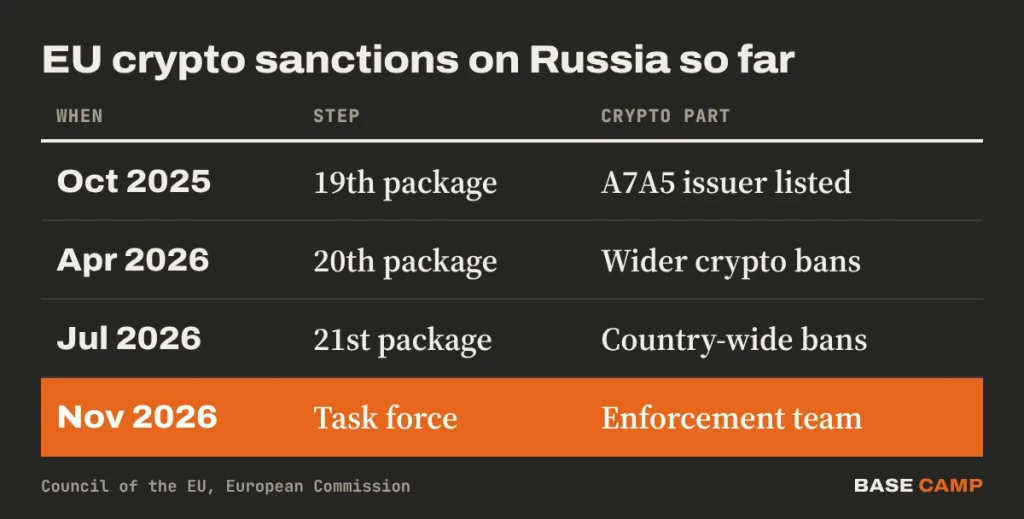
The EU’s 21st sanctions package was the big legal step: for the first time, Brussels can ban all crypto-asset services from a named third country, President Ursula von der Leyen said in July. The task force is the team that decides where that tool points.
For traders on European exchanges, nothing changes on day one. Platforms already block sanctioned names. What grows is the list, and how fast. Bitcoin sat at $75,930 at the time of writing, flat on the day. Markets aren’t pricing any of this yet.
TRAIL MAP: Bitcoin vs Altcoins vs Stablecoins vs Memecoins: What You’re Actually Buying
The clock started on November 5. If the task force keeps to 12 months, its first results should show up in the 22nd or 23rd package, well before it runs out in November 2027.

Satoshi Flipper has more than 20 years of trading experience, starting in stocks before moving into crypto in 2017, and holds an MBA from the Kellogg School of Management. The edge is reading the economic data: rate decisions, inflation, jobs numbers, earnings and the US markets that move Bitcoin.
More from Satoshi Flipper