The short version
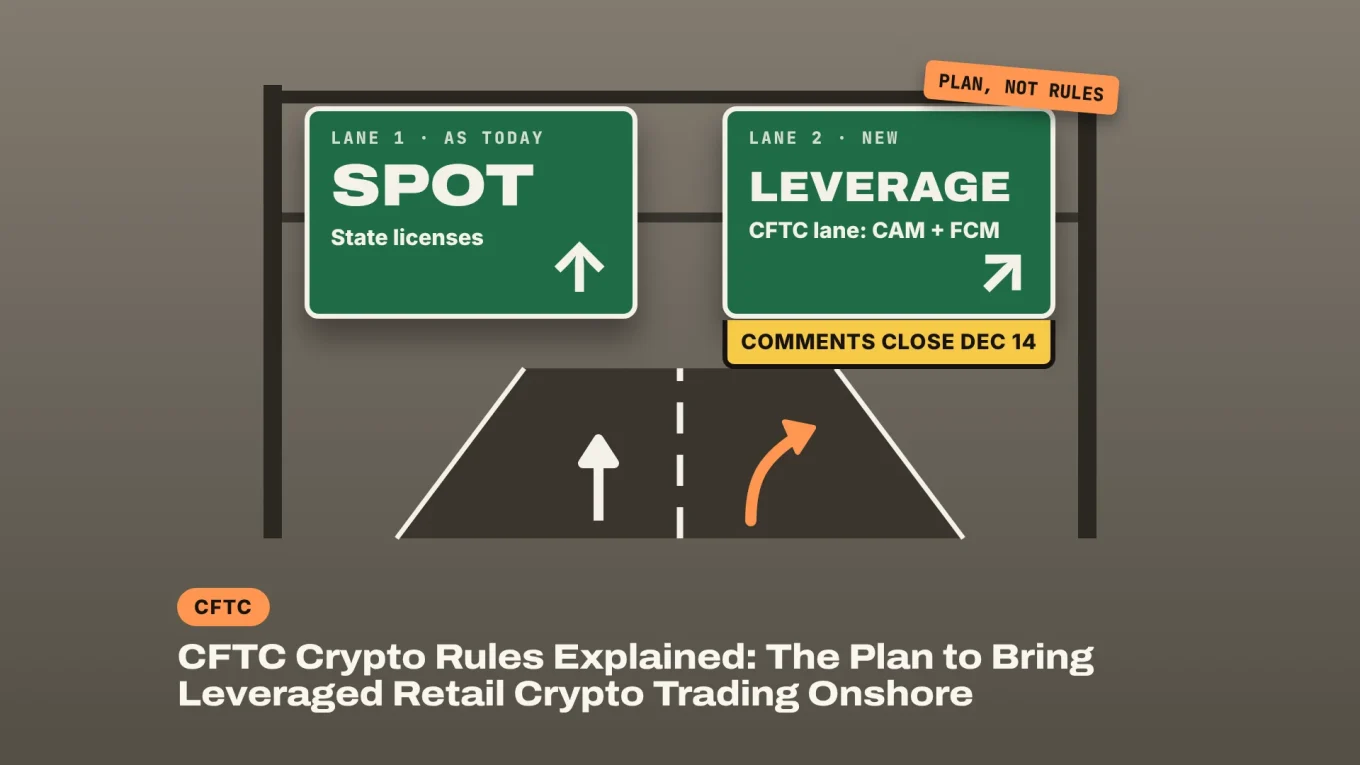
- CFTC crypto rules: on October 5 the CFTC published a 30-page plan, Regulation CTX and CAM, to bring leveraged, margined or financed retail crypto trades onto CFTC-registered venues, with comments open until December 14.
- Margin loans could only come from a futures broker (FCM) or a bank it sponsors, customer money would sit under futures-style protections, and plain spot trading with no leverage stays with state licenses.
- The crew is watching the comment letters from the big US exchanges before December 14; real rules need a second proposal and vote, so changes for traders most likely wait until 2027.
The CFTC crypto rules everyone has been waiting for finally have a first draft of the questions, and they start with leverage. On October 5, the Commodity Futures Trading Commission put out a notice on how Americans could trade crypto on margin at home, through regulated firms, instead of on offshore exchanges.
It runs 30 pages in the Federal Register, where it landed on October 13, and anyone can comment until December 14. So what is actually on the table, and what changes for a retail trader?
The CFTC shared the notice on X the day it came out:

.@CFTC Seeks Public Comment on Advanced Notice of Proposed Rulemaking Relating to Regulation Crypto Asset Transactions and Regulation Crypto Asset Markets: cftc.gov/PressRoom/Pres…
What Are the New CFTC Crypto Rules?
Not rules yet. The notice is an advance notice of proposed rulemaking (ANPRM), the step where a regulator explains its thinking and asks questions before it writes any rule text. It sketches two future rules.
Regulation CTX would define which trades count. CTX stands for crypto asset transactions: retail crypto buys offered with leverage, margin or financing. A 2010 law already says those trades belong on a CFTC-registered exchange, a designated contract market (DCM), and must be treated as if they were futures. The CFTC never wrote crypto rules for that, so US exchanges mostly stayed away. In 2021 it fined Kraken $1.25 million for offering margin trades to US customers off-exchange.
Regulation CAM would build the venue. CAM stands for crypto asset market, a lighter type of DCM license made only for these trades. Exchanges that already hold a DCM license could list them too.
Chairman Michael Selig said the goal is to “prevent, rather than only prosecute after the fact, fraudulent schemes such as FTX.”
Sponsored · Affiliate link
Save 20% on fees trading on WEEX
Base Camp may earn a commission if you sign up. It never affects what we write.
What Changes for Retail Traders?
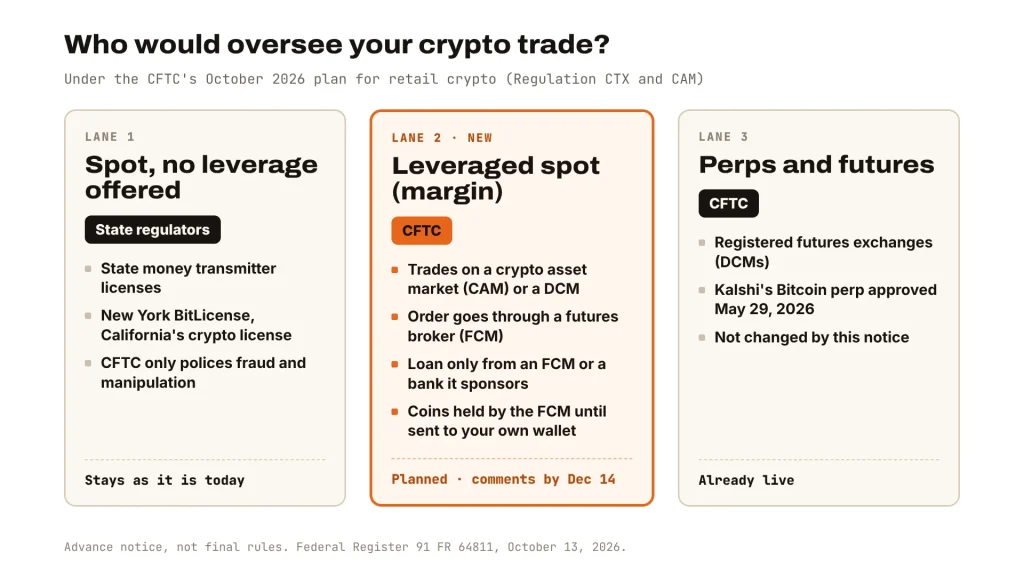
Mostly the plumbing behind a margin trade. Under the CAM plan, only a futures commission merchant (FCM), the kind of broker that handles futures accounts, or a bank sponsored by one could lend you the money for a leveraged buy.
That loan would be a separate agreement with its own terms. The FCM would hold the coins you bought, and the position gets liquidated if your margin falls below the level in that agreement. Every leverage deal would have to be listed in the exchange’s rulebook, with fees, margin and liquidation steps spelled out, and brokers would owe you risk disclosures for each coin.
A bigger change is how your money is held. Today US crypto exchanges mostly run on state money transmitter licenses, and the notice points out that some states let licensees invest customer funds in risky assets, while others set no limits at all. Futures rules keep customer money in segregated accounts, a system the CFTC says has held up for retail customers in extreme markets.
One detail matters even if you never use leverage. If an exchange offers margin to its customers, the CFTC thinks even your fully paid buys stay under its rules until the coins actually land in a wallet whose private keys you hold.
Does It Cover Spot Trading and Perps?
Not directly. Plain spot trading without any offer of leverage stays with the states: the money transmitter licenses, New York’s BitLicense and California’s crypto license. The notice says Congress never gave the CFTC power over genuine cash trades, and it asks whether exchanges can keep running under the state system by simply not offering leverage.
Perps are a separate lane. Perpetual futures are already derivatives, and in May the CFTC approved a Bitcoin perpetual contract from Kalshi on its existing exchange. This notice fills the gap in the middle: leveraged spot, the crypto margin trading US retail traders mostly can’t get at home today. If perps are new to you, our futures and leverage guide walks through margin and liquidation step by step.
DeFi gets a careful line too. The CFTC says a typical onchain app, where you keep your keys, may already count as delivery, which would keep it out of these rules. It also asks whether onchain lending vaults offered through an exchange’s app could count as an offer of leverage.
EXPLORE: Self-custody in the Base Camp glossary
When Could the CFTC Crypto Rules Take Effect?
Probably not before 2027, and nobody has a date. The comment period closes December 14. After that the CFTC has to write actual proposed rules, open a second comment round, and then vote on final rules. The public docket had only 20 comments by October 23, so the big exchanges haven’t shown their hands yet.
Companies are already moving, though. Lighter said on October 21 that it will apply for DCM and clearing licenses in November, and the Kalshi perp shows the CFTC will approve new crypto products on the current rules.
DISCOVER: Lighter CFTC Plan Sent LIT Up 12% in 40 Minutes. Two Days Later, the Pump Was Gone
The comment letters on the CFTC crypto rules are the next tell. If Coinbase, Kraken and Robinhood ask for a CAM license in their filings, US margin trading on regulated venues could become real in 2027. If they argue to stay with the states, leverage stays offshore a while longer.

In crypto since 2017, trading stocks for over 20 years. MBA. Follows the economic data and US markets closely.
More from Satoshi Flipper →