
The short version
- October 10 crypto crash: the same day, Bitcoin Core 30.0 shipped fixes for three security bugs, one rated high, that stayed secret until November 10, 2026.
- The fixes were finished by October 7 and none touched coins; the $19.13 billion of liquidations came after Trump’s 100% China tariff post and happened on exchanges.
- Anyone still on Bitcoin Core 28.0 to 29.1, miners first, should move to 30.4, 31.2 or 32.1.
Two things happened to Bitcoin on October 10, 2025. Only one of them made the news that night.
The first was Bitcoin Core 30.0, the new version of the node software most of the network runs. It quietly fixed three security bugs, one of them rated high severity. The second was the October 10 crypto crash, the biggest liquidation day crypto has ever seen.
The bugs stayed private until Tuesday, November 10, 2026, when Bitcoin Core published the details. Now crypto Twitter is asking a new question: was the 10/10 crash about more than tariffs?
Short answer: nothing in the record says so. Here is what each side actually shows.
Bitcoin Core’s own account posted the high-severity advisory on Tuesday:

"Disclosure of the details of a mempool inconsistency due to TRUC “sibling eviction” rules firing on reorg. A fix was released on October 10th 2025 in Bitcoin Core v30.0. Affected versions are 28.0 to 28.2 and 29.0 to 29.1."
What the Three Bitcoin Core Bugs Did
The worst Bitcoin Core vulnerability of the three hit miners. After a reorg, when the network swaps its last block or two for a competing chain, a mempool rule kept firing and left the node holding transactions that spent coins that no longer existed. That node could not build a valid block until someone restarted it. Bitcoin Core rates it high.
The Tor bug reached home nodes. Popular node bundles used a `-whitelist` setting that also trusted every incoming Tor peer, which the advisory says left “thousands of reachable mainnet nodes” with spam limits and privacy protections switched off for strangers.
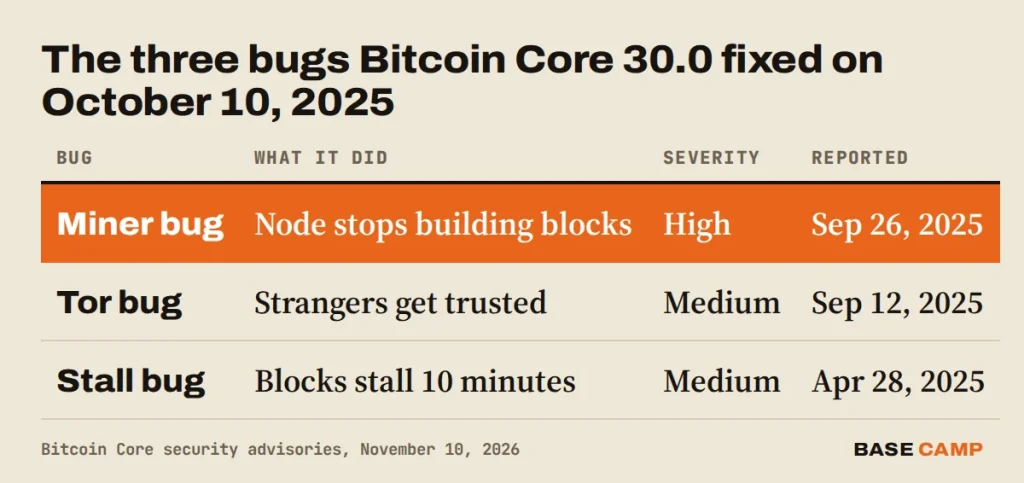
None of the three touches anyone’s coins.
Sponsored · Affiliate link
Save 20% on fees trading on WEEX
Base Camp may earn a commission if you sign up. It never affects what we write.
Did the Bugs Cause the October 10 Crypto Crash?
No sign of it. The fixes were finished weeks before the crash, and the crash happened on exchanges.
The stall bug was fixed in June, the Tor bug in September, the miner bug on October 2. GitHub shows the v30.0 tag was created on October 9 at 20:05 UTC, the evening before. This was a release on a schedule, not an emergency patch.
The crash had a different trigger. After Wall Street closed on October 10, President Trump announced a 100% tariff on Chinese imports. Bitcoin opened the day at $121,662 on Binance and hit $102,000 between 21:00 and 22:00 UTC (5 p.m. to 6 p.m. Eastern). CoinGlass counted $19.13 billion in liquidations across more than 1.6 million traders, the largest wipeout on record.
That is a leverage story. Liquidations happen inside exchange order books, and Bitcoin Core runs none of them. Binance had its own pricing trouble too: USDe, BNSOL and WBETH broke from their value on Binance between 21:36 and 22:16 UTC, and it paid about $283 million to affected users.
SIDE TRAIL: Bitcoin Core Vulnerability Found by AI Let Any Peer Crash Windows and Mac Nodes
What the Bitcoin Network Did During the Crash
So what did the chain itself do during the October 10 crypto crash? Mostly its job, with one gap that looks odd until you do the math.
Block 918486 was mined at 20:52 UTC, the next one only at 21:42. That 50-minute wait landed right in the worst hour, followed by a 44-minute one. Then five blocks came in 25 minutes.
Bitcoin blocks average 10 minutes, but they arrive at random. A wait of 50 minutes or more happens about once in every 150 blocks, roughly once a day. Block times are also set by miners and can be a few minutes off.
Fees told the real story. The median fee went from 1 to 4 sats per vbyte in the blocks before the crash to 5 to 11 in the blocks after it. Traders were moving coins, and paid up to do it.
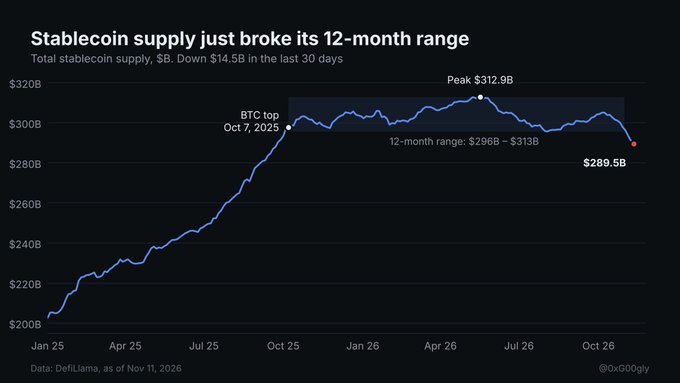
The money side took longer to heal. Stablecoin supply only grew until 10/10, Plasma’s Googly points out:

Until 10/10, stablecoin supply was up only.
After the Binance hack, it broke below its 12-month range: −$14.5B in 30 days.
Worst 30 days since Luna, a bigger drop than FTX.
But imo the glass is actually half full.
Why Bitcoin Core Waited 13 Months to Tell Anyone
Bitcoin Core keeps medium and high bugs private until the last affected version reaches end of life, so slow upgraders get time to catch up. Version 29.x reached end of life on October 27, 2026. The three advisories followed two weeks later.
That 13-month silence is exactly what makes the date look suspicious now. It is also normal.
Who should act? Miners and pools on 28.0 to 29.1 first. Then anyone running a node box with Tor and a `-whitelist` range. Move to a maintained version: 30.4, 31.2 or 32.1.
TRAIL MAP: Futures and Leverage Explained: Perps, Margin and How Liquidation Really Works
Bitcoin trades at $69,282 at the time of writing, down 5.7% in 24 hours and 45% below the $126,080 record it set on October 6, 2025, four days before the crash. On the daily chart it sits under the 200-day moving average at $73,096.
October 10 was a release day and a leverage day. Only the leverage moved the price.

TheCryptoMonk has been trading since 2017 and reads the market from the top down. The focus is macro and the high timeframes: where stocks, rates and liquidity are heading, and what the weekly and monthly charts say about Bitcoin. Short-term noise matters less than the bigger trend.
More from TheCryptoMonk