
The short version
- Drawdowns are part of every edge. Know your system’s expected worst case before you’re in it, and have rules for what you do when you get there.
- Tilt is trading from emotion after a loss (or a big win). Name your triggers and use hard stops: a daily loss limit and a forced break.
- Size up in steps, based on results, not mood. Your risk in R stays the same; only the dollars grow. Many traders fall apart when the dollars do.
- Protect the edge with routine, sleep and a journal. Your state is part of your system.
At Summit level you don’t lose money because you don’t know what a liquidity sweep is. You lose it because you knew, and did something else anyway. You moved the stop. You took the revenge trade. You doubled size after a great week and gave it all back in two days.
Psychology isn’t the soft part of trading. At this level it’s usually the part that decides results. This guide is about the specific situations where good traders break, and the practical rules that stop it.
Drawdowns are the job
Every strategy with an edge has losing streaks and drawdowns. If your system wins 45% of the time, the odds of eight losses in a row somewhere in a few hundred trades are high. If you haven’t lived through it yet, you will.
What separates traders who survive is knowing this in advance:
- Know your expected worst case. From your backtest or journal: maximum drawdown and longest losing streak. Expect live trading to be worse; a common rule of thumb is 1.5 to 2 times the backtested drawdown. See Building and backtesting your own system.
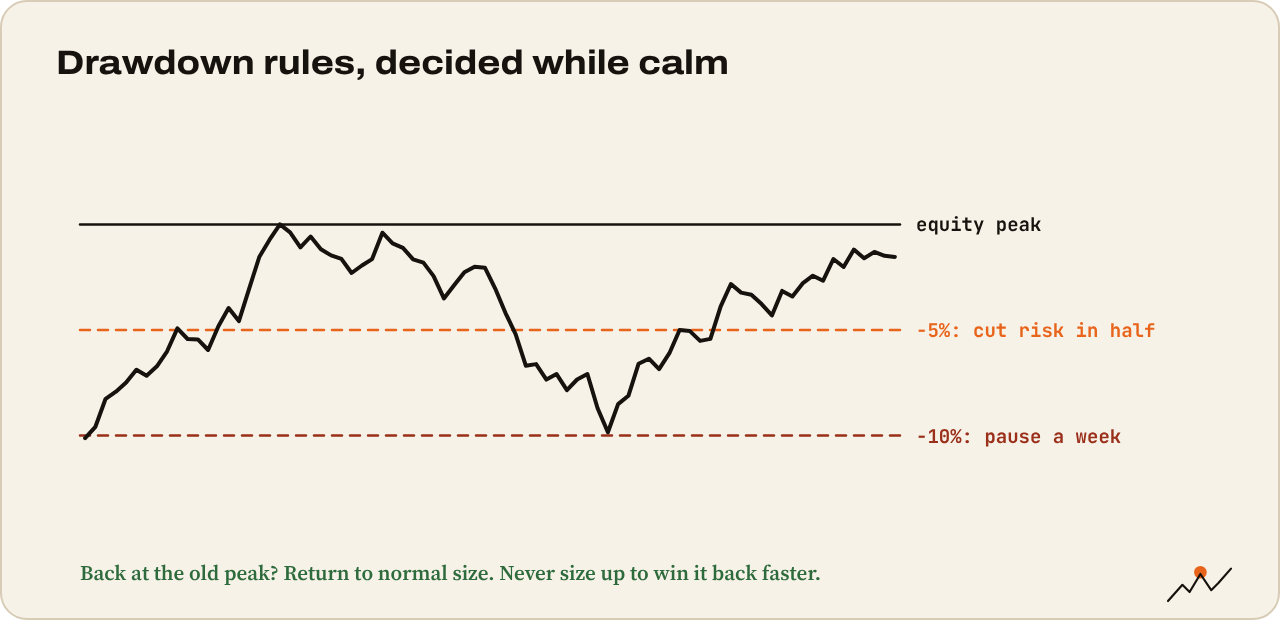
- Decide your drawdown rules now, while calm. For example: at −5% from the equity peak, cut risk per trade in half; at −10%, stop trading for a week and review every trade in the journal; back at the previous peak, return to normal size.
- Separate “system broken” from “normal bad run.” If the losses look like the backtest’s bad patches (same setups, similar sizes), it’s probably normal variance. If you’re losing on trades that break the rules, or the market has changed character, it’s a review.
The worst thing you can do in a drawdown is the most natural one: increase size to win it back faster. That turns a normal drawdown into an account-ending one. Remember the math from Risk management: −50% needs +100%.
Tilt: what it is and how to catch it
Tilt is a term from poker: playing from emotion instead of judgment after a bad beat. In trading it looks like:
- Revenge trading: jumping into a new trade right after a loss to “get it back.”
- Moving stops or removing them because “this time it will come back.”
- Size creep: each trade a bit bigger than the last.
- Overtrading: taking B and C setups because sitting still feels unbearable.
- Switching strategy mid-session: suddenly scalping the 1-minute when you’re a swing trader.
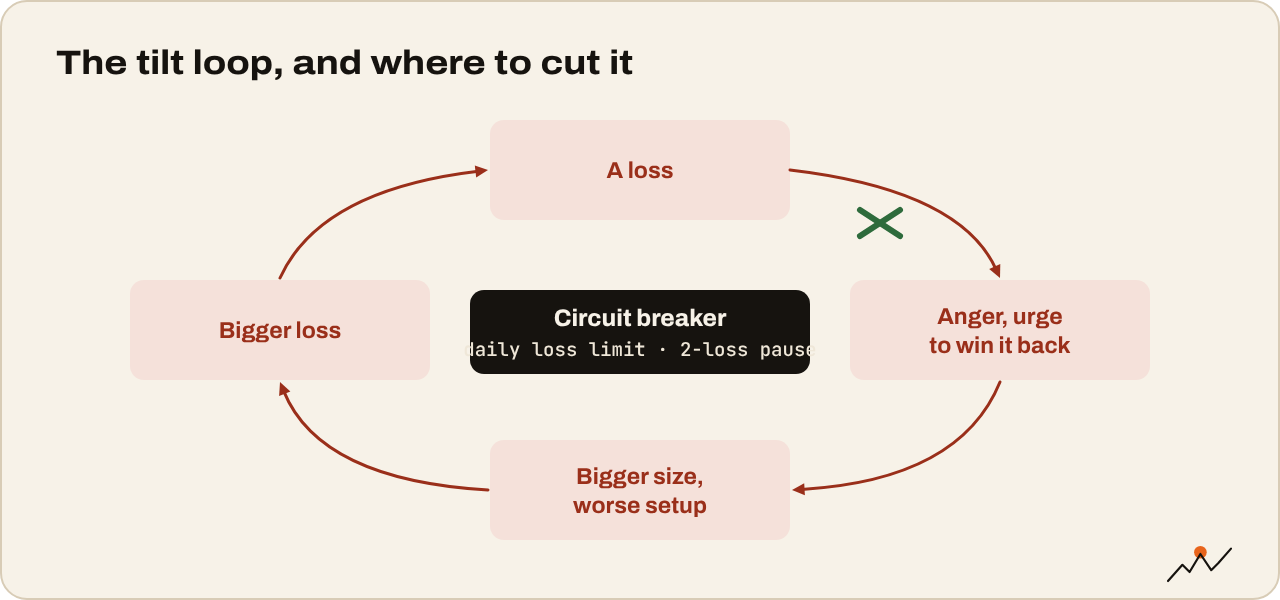
Winning streaks cause tilt too. After a great week you feel untouchable, size up and take worse trades. Overconfidence costs as much as anger.
Name your triggers
Your journal shows them. Look at your worst trades and what came before: a loss, a missed move, a fight at home, two hours of sleep, a friend posting gains. Write your personal triggers down. When one shows up, it’s a signal to slow down.
Hard circuit breakers
Willpower fails under stress. Rules that don’t need willpower work better:
- Daily loss limit: after −2R (or −2% of equity), you’re done for the day. Close the platform.
- Two-loss pause: after two losses in a row, a 30-minute break away from the screen before the next trade.
- Maximum trades per day.
- No trading when tired, drunk, sick, or within an hour of a big emotional event.
- Physical barrier: some traders lock themselves out with exchange cooling-off settings, or log out and hand the phone to someone.
Tip. Trader Mayne’s Why You’re Over-Trading (And How To Fix It) is a good, recent take on taking fewer and better trades.
Sizing up without breaking
Here’s a paradox many traders hit. A system works fine at $100 risk per trade. At $1,000 per trade, the same trader starts hesitating, cutting winners and moving stops. Nothing about the market changed. The dollar amounts did.
How to grow size without growing fear:
- Size up in steps, on rules. For example: increase risk per trade by 25% after every 50 trades with positive expectancy and drawdown inside limits. Never size up after a single great week.
- Keep risk in R, and think in R. If 1R stays 1% of equity, your account grows and your trades grow with it, automatically. Track results in R, not dollars, to keep the emotional weight constant.
- Check liquidity. Larger orders move price more, especially on altcoins. Slippage that didn’t matter at small size can eat your edge at large size. Use limit orders and check order book depth (see Reading order books, funding and open interest together).
- Watch for behavior changes. If your journal shows more early exits or stop changes after a size increase, step back down. Grow your comfort, then grow size.
- Pay yourself. Regularly withdraw part of the profit. It makes gains real and lowers the pressure to “protect the number.”
Detach from single outcomes
One trade means almost nothing. A great trader can lose on a perfect setup; a bad trader can win on a terrible one. If you judge yourself trade by trade, the market will drive you mad.
- Judge process, not outcome. In your journal, grade each trade on whether you followed the plan, separately from whether it made money. A rule-following loss is a good trade.
- Think in batches. Your edge shows up over 50 or 100 trades. Review in batches, not after each trade.
- Expect to be wrong. Write the stop before the entry and accept the loss when you place the order. Then a stop-out is just the plan working.
The trader’s operating system
Your brain is part of your system. Treat it like one:
- Sleep. Decision quality falls sharply when you’re tired. Many 3 a.m. trades are tilt in disguise.
- Routine. A fixed pre-market routine (levels, news, checklist) puts you in “process” mode before you click anything.
- Limited screen time. The market is open 24/7; you don’t have to be. Set alerts at your levels and leave.
- Body. Exercise, food and breaks reduce stress, and stress drives impulsive decisions.
- Social media diet. Constant exposure to other people’s winning screenshots is a reliable trigger for FOMO and size creep.
- A trading partner or community: someone who can say “you’re on tilt” is worth more than any indicator.
Watch out. If trading is hurting your finances, sleep, relationships or mental health, stop and step away. Those are signs of a problem bigger than a strategy, and talking to someone, a friend, a doctor or a gambling support service, is the strong move, not the weak one.
Your psychology rules
- I know my system’s expected max drawdown and longest losing streak
- My drawdown rules are written: when I cut size, when I pause, when I return
- I know my personal tilt triggers
- Daily loss limit and two-loss pause are in my plan
- I size up only in steps, after a set number of trades, never after one good week
- I grade trades on process separately from outcome
- I don’t trade tired, angry or right after a big loss
- I withdraw part of my profits regularly
The end of the trail, for now
That’s the top of the mountain. Across these guides you’ve gone from what a blockchain is to building and stress-testing your own system. The tools stay the same at every altitude: protect your capital, follow a plan, keep a journal and stay honest with yourself.
If you want to revisit the foundations, Writing your own trade plan and Keeping a trading journal are worth rereading at any level. And the Field Kit has every calculator from these guides in one place.

On the climb since 2017. Trades futures and reads onchain data. Automates the boring parts.
More from VikingXBT →